

One State. One System.
Ideas to Impact.
Nucleus connects Utah’s researchers, companies, talent, investors and public partners to help ideas reach the people who can put them to work.
The convergence imperative
Utah has the pieces.
Connection is the opportunity.
Utah has the research, talent and ambition to solve difficult problems. Nucleus helps people find the expertise, collaborators and resources to do it together.
Read the case for convergence →Find What You Need
Start with your next move.
Start with what you are trying to do. The resource finder routes you toward the people, programs and institutions that can help.
Open the resource finder →01 / The statewide architectureFrom discovery to impact
One network. One connector. One front door.
Different strengths.
One connected system.
02 / How Nucleus worksStable roles, flexible programs
Convene. Educate. Fund.
Three jobs that make connection useful.
We convene people around shared challenges, build practical skills and connect promising work with funding.
Convene
Bring the right people together.
Build relationships and shared context around sectors, opportunities and challenges that cross institutional lines.
Educate
Level up expertise to move ideas forward.
Give founders, researchers, students and partners practical ways to learn, translate and act.
Fund
Put resources behind momentum.
Connect work ready to move with capital, federal funding, market access and the support required to go further.
The Convergence Corridor
Statewide by design
Utah's innovation economy is statewide by design. Distinct regional strengths connect as one system, from northern Utah through the Wasatch Front to southern Utah.
Explore the Convergence Corridor →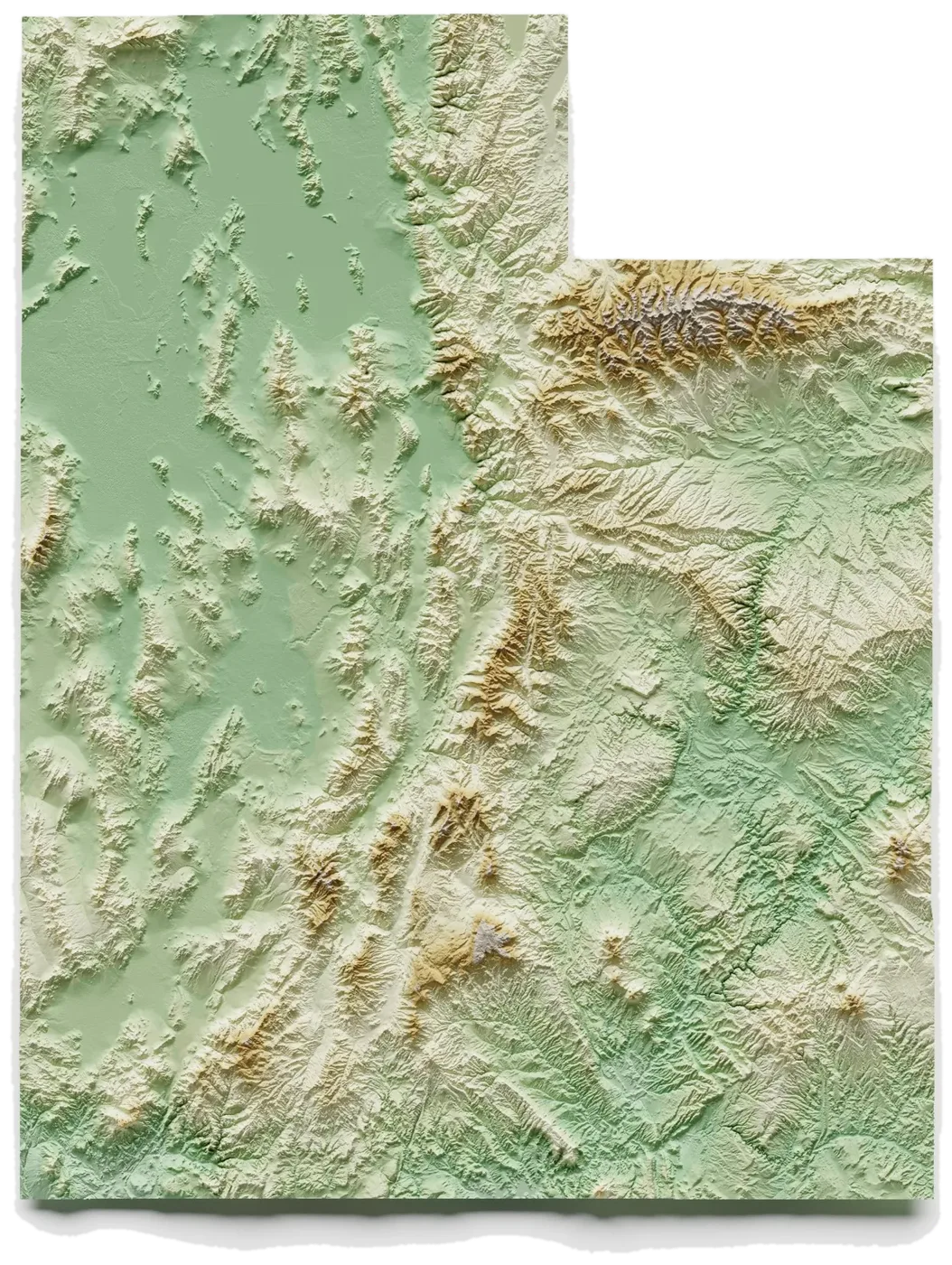
Now at Nucleus
Connection in motion.

National Institutes of Health Award Inherent Biosciences a Direct to Phase II SBIR Grant
Inherent Biosciences, a Salt Lake City molecular diagnostics company, has been awarded a Direct to Phase II Small Business Innovation Research (SBIR) grant from the National Institute of Child Health and Human Development (NICHD)…
Read story ↗The next connection starts here
What could you move forward?
Tell us what you're working on. We'll help you find where it connects.
Connect with Nucleus →
The convergence imperative
Utah's next advantage is
connection.
Utah has the research, talent, companies and capital to do ambitious work. Nucleus helps them connect across institutional boundaries so more ideas reach the people who can use them.
01 / Why now
The biggest opportunities are forming between disciplines.
Research and business challenges rarely fit within one discipline. Shared context and early collaboration help people work toward the same outcome.
AI + HealthQuantum + DefenseEnergy + ManufacturingWater + Agriculture
02 / The gap
Strong institutions do more together.
Universities discover. Companies build. Investors provide capital. Public partners and communities shape needs and opportunities. Nucleus helps those people find one another and work together.
03 / The model
Onestatewide system.Oneconnector.Onephysical front door.
Convergence Corridor
The statewide network linking Utah's research, industry, talent, capital and public assets.
Nucleus Institute
The neutral connector that helps those strengths find one another and move together.
ConveneEducateFund
PHYSICAL FRONT DOORConvergence Point
The place where the statewide system becomes tangible. People meet, demonstrate, translate and build here.
Explore the Point →Statewide Impact
More research translated into market and public use, more companies scaling, and more teams forming around consequential problems.
04 / The vision
Our ambition: make Utah America’s fastest place to turn ideas into impact.
Research reaches market and public use. Companies scale in Utah. Capital and expertise find promising work. Talent finds opportunity. Teams form around consequential problems that cross institutional boundaries.
Find your path into the system →What Nucleus doesConvene · Educate · Fund
01
Convene
Bring people together around shared work.
Purposeful convening gives the right people a reason to build together and move from introductions to action.
Converge AIUniversity–industry forums moving statewide.State of InnovationUtah's annual moment to align around the innovation economy. CatalystsExpert forums around emerging priorities and sectors. EventsFocused gatherings that connect Utah's innovation ecosystem.
02
Educate
Turn complexity into a clearer next step.
Researchers, students and operators need practical translation. Nucleus gives them market context, tools, mentoring and real-world experience.
MarketEdgeCommercialization training for Utah researchers.ProLabStudent teams applying their skills to real industry challenges. Industry WorkshopsPractical sessions connecting innovators with industry expertise, market insight and commercialization know-how. University EngagementBringing commercialization education and ecosystem access directly to Utah campuses through programs such as Boost.
03
Fund
Get the right resources behind promising work.
Nucleus helps innovators navigate the full capital landscape: equity, federal non-dilutive funding, investor relationships and the support required to commercialize.
Nucleus Fund$40M evergreen, state-backed venture capital for Utah deep tech.Nucleus GrowSBIR/STTR funding and grant support for Utah innovators.Capital connectionsCurated access to investors and strategic partners. Commercialization supportShared expertise that helps good work keep moving.


Find the funding to advance your technology.
Get guidance on Small Business Innovation Research (SBIR) and Small Business Technology Transfer (STTR) opportunities, proposal development and funding pathways for your Utah company.
Book a Grow consultation ↗For Utah startups and small businesses. Consultations, proposal editing and guidance are available at no cost; some events may charge a fee.
Our mission
Turn bold ideas into market-ready solutions.
Nucleus Grow helps Utah technology companies prepare for research funding and commercialization. Work with the team to identify suitable opportunities, strengthen proposals and plan your next funding milestone.
01 / FindIdentify the right funding pathway.
02 / BuildStrengthen the proposal and readiness.
03 / AdvanceMove technology toward market.
Why Nucleus Grow
Built to help Utah innovators move.
From finding the right federal opportunity to navigating proposal requirements and connecting into Utah’s broader innovation network, Grow gives founders a clearer path through a complex funding landscape.
01 / GUIDANCE
Federal funding guidance
We are Utah’s official resource for the SBIR and STTR programs, helping companies prepare competitive proposals and win non-dilutive funding.
02 / NETWORK
Connections across Utah
We link founders with universities, industry partners, investors, and government resources to accelerate technology from lab to market.
What we do
Practical support at the points that matter.
Grow combines funding navigation, proposal assistance, and founder education so companies can spend less time deciphering the process and more time advancing the technology.
01 / SUPPORT
SBIR/STTR Support
We help Utah companies prepare and submit strong SBIR and STTR proposals, from registrations and budgeting to narrative reviews and final submission.
02 / PATHWAYS
Funding pathways
We help companies explore federal research awards, the Utah Technology Innovation Fund (UTIF) and follow-on funding options.
03 / PROPOSALS
Topic matching and proposal services
Our team provides coaching, proposal review and editing, and topic matching in your non-dilutive funding search process.
04 / LEARNING
Training and workshops
We host regular workshops and one-on-one sessions to help founders understand agency requirements, strengthen proposals, and learn from peers.
SBIR 101 Workshop
Understand federal research funding.
SBIR and STTR fund small-business research and development. Learn how to evaluate an opportunity, prepare a proposal and understand the requirements of an award.
Nucleus Grow is Utah’s official resource partner for helping entrepreneurs win SBIR/STTR awards. We offer:
- Opportunity Matching – Guidance to help identify the right agency and topic fit
- Proposal Development – Templates, coaching, and hands-on reviews
- Agency Expertise – Insights into NIH, NSF, DoD, DOE, USDA, NASA, and more
- Grant Readiness – Support with registrations, budget prep, and compliance checklists
SBIR/STTR workshops
Join an SBIR/STTR workshop to understand the process, ask questions and strengthen your proposal. See the event calendar for upcoming dates and registration details.
Attend Our SBIR 101 Workshop ↗How to get started
A clearer route from idea to application.
Use these steps as a practical starting sequence. Grow can help you understand where you are in the process and what comes next.
Frequently asked questions
Start with the basics.
Answers to common questions about Grow, SBIR/STTR, eligibility, and the application process.
How much do Grow services cost?
Consultations, editing and guidance are available at no cost to Utah businesses. Events, including workshops and seminars, may have nominal fees.
What are the SBIR and STTR programs?
SBIR and STTR grants and contracts support small-business research and development, helping companies test ideas and advance technologies toward commercialization.
Participating federal agencies publish research topics, application requirements and award terms. Grow can help you identify the opportunities that fit your technology.
How much funding is available and what can it be used for?
This non-dilutive funding is offered in competitive phases:
- Phase I typically offers $150,000 to $250,000 for a six-month project to prove the feasibility and technical merit of your idea or technology.
- Phase II typically offers $1 to $1.5 million for a 24-month project and is meant to expand the Phase I results and evaluate commercial potential.
- Phase III takes place as the technology moves from the laboratory to the marketplace. While SBIR-STTR funds do not support this phase, some agencies offer sole-source contracts or follow-on non-SBIR funded research and development to help the small business commercialize a product.
What does that company 'give up' to get these funds?
SBIR/STTR awards do not require an equity investment in your company. Intellectual-property rights, reporting obligations and other conditions depend on the award. Review the agency’s terms with Grow before applying; visit SBIR.gov for program guidance.
What agencies participate?
Agency participation and open solicitations can change. Check SBIR.gov and the relevant agency’s current announcement before planning a submission.
You can search for open topics at Open Topic Search ↗. For links and guidance on SBIR /STTR funding, you can go to SBIR.gov ↗ or any of the individual agencies participating in the programs:
- Department of Agriculture (USDA)
- Department of Commerce
- National Institute of Standards and Technology (NIST)
- National Oceanic and Atmospheric Administration (NOAA)
- Department of Defense (DoD)
- Department of Education (DoED)
- Department of Energy (DOE)
- Department of Health and Human Services (DHHS)
- Department of Homeland Security (DHS)
- Department of Transportation (DOT)
- Environmental Protection Agency (EPA)
- National Aeronautics and Space Administration (NASA)
- National Science Foundation (NSF)
Who is eligible for SBIR-STTR funding?
Utah businesses pursuing SBIR/STTR opportunities can work with Nucleus Grow. Confirm federal eligibility against the current solicitation; common requirements include:
- For-profit company
- American-owned
- At least 51% owned by individuals
- 500 or fewer employees
Who is eligible to work with Nucleus Grow?
- The company must be headquartered in Utah.
- And be registered with Utah’s Division of Corporations* or will be upon SBIR/STTR submission.
*Can be incorporated in another state and registered as a foreign LLC with Utah’s Division of Corporations and Commercial Code
Why work with Nucleus Grow?
Grow offers agency-specific task lists, templates, proposal reviews, editing and guidance. Consultations and proposal support are available at no cost to Utah businesses.
What is the UTIF program?
The Utah Technology Innovation Fund is a program sponsored by the State of Utah offering to eligible Utah Small Businesses a microgrant ($3,000-$5,000) for first-time SBIR/STTR Phase I applicants, and a Nonrecourse Loan ($50,000-$60,000) to SBIR/STTR Phase II applicants. For more information about the UTIF program and how to apply, please see our UTIF page ↗.
Is my technology a good fit for the SBIR/STTR program?
The proposed technology must be in the early stages of research and development (experimental and untested technology), not yet commercialized, and directly address a “topic” from one of the participating federal agencies.
Depending on the federal agency, a “topic” may reference a broad mission or a specific problem to solve. Applicants are invited to propose and develop a new technology that directly addresses the topic.
Contact grow@nucleusutah.org to assess if your proposed technology is a good fit under the SBIR/STTR program.
Latest
From Nucleus Grow
Recent program updates, funding news, and stories from Utah’s innovation ecosystem.
NEWS / FEATURED
May 2026 SBIR/STTR Solicitations
Since Reauthorization in April, five federal agencies have listed solicitations for the SBIR/STTR programs.
Read More →NEWS
2026 Utah Governor's Science Medals Award Ceremony
The 2026 Recipients of the Utah Governor’s Medal for Science and Technology received their awards at a ceremony held April 29th at the State Capitol.
Read More →NEWS
The Nucleus Institute Announces Convergence Point: Utah's First Innovation Campus
Economic infrastructure facility at The Point in Draper will unite universities, industry, government, and global innovation partners under one roof by 2029.
Read More →NEWS
Utah's Terrestrial LLC Secures Navy SBIR Award
Utah-based Terrestrial LLC secures a U.S. Navy SBIR award, advancing cutting-edge defense technology and strengthening the state’s innovation ecosystem.
Read More →NEWS
Redefining Male Fertility: Inside Inherent Biosciences’ Growth
Utah-based Inherent Biosciences is advancing male fertility care with breakthrough epigenetic diagnostics that help identify hidden infertility factors and guide more effective paths to parenthood.
Read More →NEWS
Utah-based InnoSys Receives AFWERX Manufacturing Challenge Award
InnoSys, Inc. was awarded a Direct to Phase II contract for $1.75M through the AFWERX and SpaceWERX Manufacturing Challenge.
Read More →FAST partnership
Expand access to SBIR/STTR support.
Nucleus Grow is the Federal and State Technology (FAST) Partnership awardee for the state of Utah. Administered by the Small Business Administration (SBA), FAST funds state and regional organizations to boost SBIR/STTR proposals and awards.
FAST awards strengthen the SBIR/STTR ecosystem by:
Offering training and outreach
Collaborating with partner organizations
Providing technical and business assistance
Offering financial support

Nucleus Grow
Utah Technology Innovation Fund
The Utah Technology Innovation Fund (UTIF) supports eligible Utah small businesses pursuing federal Small Business Innovation Research (SBIR) and Small Business Technology Transfer (STTR) awards.
Funding opportunities
Support for Utah SBIR/STTR applicants and winners.
Utah applicants and winners can apply for the following funding opportunities:
Microgrants
Eligible Phase I applicants may seek microgrants to offset the costs of submitting a competitive SBIR/STTR proposal. Applicants may receive $3,000 (up to $5,000 for rural businesses) after the successful submission of a Phase I SBIR/STTR proposal.
Nonrecourse loans
Eligible Phase I winners may seek nonrecourse loans to help bridge the gap between Phase I and Phase II SBIR/STTR R&D efforts. Applicants may receive $50,000 in gap funding (up to $60,000 for rural businesses) after the successful submission of a Phase II SBIR/STTR proposal.

Frequently asked questions
UTIF FAQs
What are the SBIR and STTR programs?
The SBIR and STTR programs are America’s Seed Fund. These highly competitive federal programs fund small business research and development of innovative technology with the potential for commercialization.
Attend the free, monthly SBIR 101 Workshop to learn more about SBIR/STTR.
How do I find an SBIR/STTR solicitation?
Utah small businesses seeking funding opportunities under the SBIR/STTR programs can perform searches for specific agency solicitations at SBIR.gov.
Can I apply before identifying an SBIR/STTR solicitation?
To qualify for the UTIF program, you must specify an eligible and open SBIR or STTR solicitation within your UTIF application. Please wait to apply to UTIF until you've identified the SBIR or STTR solicitation you plan to pursue.
Will the submission system accept multiple attachments, or should I upload them as a merged document or zip file?
Upload each document separately; do not merge them into a single file or zip file. The office portal accepts multiple attachments.
When are UTIF applications due?
UTIF applications should be submitted via the submission portal at least four weeks before the related SBIR/STTR submission deadline.
We recently submitted a Phase I SBIR/STTR proposal. Are we eligible for the microgrant?
Phase I awardees cannot request a microgrant for a previous submission. However, if the company submits another Phase I proposal, you could be eligible for the microgrant if the company has not been awarded a Phase I award within the last five years and is working with Nucleus Grow. There is a limit of one microgrant per company.
Are Phase II awardees eligible to apply for a nonrecourse loan?
Phase II awardees cannot request a nonrecourse loan for a previous submission and/or award. However, you may be eligible to apply for a nonrecourse loan if your business received a SBIR/STTR Phase I award and is planning to submit a corresponding Phase II proposal with the assistance of Nucleus Grow. There is a limit of two nonrecourse loans per company.
Do I need a business license?
Although a business license is not required under the UTIF program, your company may be required to obtain one depending on your local jurisdiction. A valid business registration with the Utah Division of Corporations and Commercial Code is required under the UTIF program. For business guidance and available resources, please visit the Startup State Initiative website at startup.utah.gov.
What business registrations are needed under the UTIF program?
To qualify for UTIF, you must complete the following registrations prior to submitting your UTIF funding application:
Is UTIF competitive funding?
UTIF support is subject to program eligibility and available funding. Review the current program announcement and confirm availability with Grow before applying.

Application
How to submit a UTIF application
- Identify an eligible, open SBIR/STTR opportunity and its submission deadline.
- Contact Nucleus Grow to discuss eligibility and allow at least four weeks before the federal deadline.
- Gather the required registrations and documents. If you need portal access, ask Grow for the current account setup instructions.
- Submit your UTIF application through the state portal and obtain Grow’s pre-approval before submitting the federal proposal.
For access or application questions, email grow@nucleusutah.org. Funding depends on eligibility and availability; review the current program announcement before applying.
Read the application guide ↗
Nucleus Grow
Governor’s Medal for Science and Technology
Nominations for the 2026 Governor’s Medal for Science and Technology are closed. Check back for 2027 nomination information.
Governor’s Medal
Recognizing science and technology achievement since 1987.
Since 1987, the Governor’s Medal for Science and Technology has recognized the distinguished service, significant achievements, and positive economic impact of individuals and companies to the state of Utah and beyond in science and technology.
Medal recipients provide meaningful scientific, research, STEM education, or deep technology contributions.
Nominations are accepted in one of three categories:
- Academic/Research
- Education – K-12
- Industry – Individual or Company

Nominations
Nomination Information
Nominations for the 2026 Governor’s Medal for Science and Technology are closed. Check back for 2027 nomination information.
Governor’s Medal
About the Medal

The Office of the Governor and The Nucleus Institute administer the medal collaboratively. A volunteer committee reviews nominations, and recipients are recognized annually.
Selection criteria
Considerations by category.
Selection considers a nominee’s overall contribution to Utah through science and technology, including achievements in research, education, industry and economic development. The criteria below describe considerations for each category.
Nomination categories include:
- Academic/Research
- Education – K-12
- Industry – Individual or Company
Academic/Research
For members of the faculty or administration of higher education institutions who distinguished themselves in the field of science, engineering, or other technologies, these additional factors should be considered:
- Quality of research activities
- The extent of recognition by peers
- Recognition as an educator
- Personal research and science achievements
Education – K-12
For science teachers in Utah’s elementary and secondary schools, science communicators, and other individuals who made notable contributions to science education, these additional factors should be considered:
- Degree of national or local recognition as a science educator
- Involvement in innovative science education activities outside of the classroom
- Other awards received in recognition of teaching achievements
- Personal research and science achievements
Industry – Individual or Company
For the individual categories (engineers, scientists, technologists, and technology managers within Utah’s industry) and the company category, these additional factors should be considered:
- Quality of scientific or engineering achievement
- Significance of technical contributions, including patents, know-how, and other intellectual property
- The economic impact on Utah
- Distinguished achievements in the management of technology
For additional information, please contact grow@nucleusutah.org.
Previous medal recipients
A legacy of achievement.
2026
Academic/Research — D. Kip Solomon, PhD
Kip Solomon is an internationally recognized and distinguished hydrologist who has pioneered novel methods to understand one of the most precious resources on our planet: water. Currently the Francis Brown Endowed Chair in the Department of Geology and Geophysics at the University of Utah, Solomon’s long career exemplifies excellence in research, in the classroom, supervision of graduate students, leadership, service, his profession, and the world at large. He has developed innovative methods for determining groundwater age and invented water sampling technologies used internationally.
His contributions advance the understanding of the water cycle and the vulnerability of resources to over-exploitation. Additionally, his expertise in addressing industrial water contamination benefits communities worldwide. The UN International Atomic Energy Agency frequently consults him for field studies on water use in developing nations.
Solomon’s research includes the use of environmental tracers to evaluate groundwater flow and solute transport processes in local- to regional-scale aquifers. He has helped develop the use of dissolved gases to evaluate groundwater ages, travel times, location, and rates of recharge, and the sustainability of groundwater resources. He operates one of only a few labs in the world that measure noble gases in groundwater. Solomon holds a Ph.D. in Earth Sciences from the University of Waterloo and holds degrees in Geology and Geological Engineering from the University of Utah.
K-12 Education — Teresa Hislop
Teresa Hislop is a 30-year educator recognized by her colleagues as the most inspiring and committed educator, who invests her heart and soul in STEM education. Described as a master educator, Hislop’s commitment to experiential STEM learning extends far beyond the classroom. She organizes immersive field experiences that bring science to life in unforgettable ways. On a trip to the Oregon Coast, middle schoolers conduct field studies, explore tide pools, and work in professional science facilities.
In Newport, they dissect squid in a working science classroom and collaborate in hands-on investigations and robotics work. Students who might never otherwise have seen the ocean become marine biologists for a week.
Beyond her classroom, Hislop is a generous colleague and mentor. She shares resources freely, supports interdisciplinary collaboration, and serves as a beacon of light within the school community. Her enthusiasm is infectious, her standards are rigorous, and her dedication is unwavering.
Hislop currently teaches 8th-grade science at the Ogden Preparatory Academy and has been recognized by peers with several awards, including the Air Force Association State Teacher of the Year, Utah State Board of Education Teacher of the Year Runner-up, and the Utah Ag in the Classroom Teacher of the Year. Hislop received degrees from Brigham Young University and the University of Utah.
Industry — Jennifer Hwu, PhD
Jennifer Hwu has pushed the boundaries of high-frequency power amplifiers for space, telecommunications, aerospace, avionics, and terrestrial applications, and is a pioneer in extreme environment electronics. As co-founder, president, and CEO of InnoSys, Inc., she has successfully led numerous research and development projects for the Department of Defense/War, Department of Energy, NASA and other agencies, resulting in products that are designed and manufactured at InnoSys’s facility in Salt Lake City.
She has mentored and taught numerous STEM employees and students and is a role model, both at her company and as a former tenured professor of Electrical and Computer Engineering at the University of Utah.
Hwu’s economic impact includes bringing private funding and highly competitive grants and contracts to Utah and building a 36,500 square foot combined office, R&D, manufacturing, and testing facilities in Salt Lake City, directly employing and supporting a significant number of technical staff.
She is highly sought after to serve on technical committees of premier conferences in radio frequency, from microwaves to terahertz, and has led and been instrumental in achieving world records in extreme electronics and communications performance.She received national recognition, including from the National Science Foundation, the Office of Naval Research, and the White House, recognizing her professional achievements.
These have influenced and greatly shaped her unwavering desire to help others and to advance Utah and the U.S. She received her PhD from the University of California, Los Angeles, in Electrical Engineering.
Government — Jed Hancock, Ph
Jed Hancock is the president of the Utah State University (USU) Space Dynamics Laboratory (SDL), one of only 15 University Affiliated Research Centers (UARCs) in the nation. His background in electrical engineering and optical science, and his ability to lead people and complex organizations, have resulted in achievements that have advanced science, strengthened national defense, and elevated Utah’s reputation on the global stage.
Under his leadership, SDL developed the camera suite for NASA’s Origins Spectral Interpretation Resource Identification and Security-Regolith Explorer (OSIRIS-REx) mission, the first U.S. mission to return samples from an asteroid to Earth.
He has been instrumental in building strategic partnerships with organizations such as the Naval Research Laboratory and the University of California, Berkeley, contributing to major national and international efforts, including the NASA Ionospheric Connection Explorer (ICON) mission and its advanced scientific instrumentation. These collaborations reflect both his technical expertise and his ability to build and lead effective partnerships to address complex challenges.
Hancock played a key role in securing an Air Force Research Laboratory contract with a potential value of up to one billion dollars. Since 2021, SDL has grown from approximately 800 employees to more than 1,300 today, with revenues increasing to over $354 million in 2025. This growth has created high-quality jobs, strengthened Utah’s workforce, and expanded the state’s role in advanced aerospace and defense research. He received his PhD in Optical Sciences from the University of Arizona.
We congratulate these awardees for their dedication, passion, and commitment to science and technology and look forward to their continued impact on our community and the world.
2025
Academic/Research — Dr. M. Denise Dearing
Dr. Dearing is a renowned ecologist whose pioneering research has advanced the field of ecology and helped position Utah as a leader in scientific innovation. She embodies the highest standards of excellence, educational leadership, and service to Utah’s values.
As the inaugural associate dean for research for the College of Science and later chair of the Department of Biology at the University of Utah, her leadership and vision have been instrumental in transforming the department into the School of Biological Sciences. Some of her many honors include the Distinguished Scholarly and Creative Research Award, the C. Hart Merriam Award, and being named a distinguished professor by the University of Utah.
Dearing has published more than 180 peer-reviewed publications with over 11,500 citations and has received extensive external funding to support her research projects. Her contributions continue to inspire students, peers, and future generations of scientists.
Industry — Mr. Sidney J. Green
Sidney Green is an engineer and entrepreneur who helped shape Utah’s high-tech industry. As founder, president, and CEO of TerraTek, he positioned Utah as a leader in geomechanics analysis, sparking economic growth that led to the development of other technology companies across the state.
Green has played a pivotal role in advancing science and engineering in Utah. He advised the governor and Legislature as a member of the Utah Science Council and was the founding chair of the Utah Technology Finance Corporation. In 1994, he was elected to the National Academy of Engineering — one of only 15 members from Utah to serve in this capacity. He holds 24 patents, has published 119 peer-reviewed papers, and is internationally recognized for his groundbreaking technical achievements.
K-12 Education — Dr. Nicola Hack
Dr. Hack started her career in education after earning a Ph.D. in developmental neurobiology and working as a research scientist. Realizing a need for early STEM education, she collaborated with fellow experts to launch a science-focused charter school. Her commitment to interdisciplinary, science-based learning continues to shape students’ educational journeys.
Over the years, Hack’s visionary leadership has created impactful opportunities for students to excel while supporting future educators and leaders. Her leadership, unwavering commitment to equitable STEM education, ability to develop teacher capacity, and transformative impact on students exemplify excellence in education.
2024
K-12 Education
Juliette Bautista Barahona, Founder and Director, Club Ability
Juliette Bautista is dedicated to fostering an inclusive and accessible environment. As the founder and director of Club Ability, she instituted a transformative approach to teaching technology. She began her journey working with children with disabilities.
From there, Club Ability expanded to fill a void in providing STEM education to girls and women and their families, especially those in Hispanic families that are sorely underrepresented in the field, where Latinos make up only 7% of Utah tech jobs despite being 15% of the Utah population. She has served nearly 1,000 K-12 students, primarily from low-income families.
Since Club Ability’s 2019 inception, the educational programs have served a Utah population that’s 93% low-income, 98% Latinx, and 20% have a disability.
Academic/Research
Cornelia Ulrich, Ph.D., M.S., Chief Scientific Officer and Executive Director of the Comprehensive Cancer Center, Huntsman Cancer Institute, University of Utah
Dr. Cornelia Ulrich is an internationally recognized cancer epidemiologist/cancer prevention scientist and an accomplished leader. She is the chief scientific officer and the executive director of the National Cancer Institute-designated Comprehensive Cancer Center at Huntsman Cancer Institute (HCI) and the Jon and Karen Huntsman Presidential Professor in Cancer Research in Population Health Sciences at the University of Utah. Dr.
Ulrich’s research focuses on lifestyle and biological factors in cancer prevention and prognosis. Throughout her career, she has committed herself to developing and leading organizations, multidisciplinary teams, and international consortia that seek to advance scientific discovery focused on cancer prevention in critical areas. Her leadership of HCI has led to its growing impact on cancer prevention, care, and control in Utah and beyond.
Industry
Gregory C. Critchfield, M.D., M.S., EarlyDiagnostics, Inc., Sera Prognostics, Inc., Myriad Genetics, Inc.
Dr. Critchfield is a successful business executive. In 1995, he became senior vice president and chief medical and science officer of Corning Clinical Laboratories/Quest Diagnostics, responsible for science, medicine, and innovation across the U.S. In 1998, he became president of Myriad Genetic Laboratories, building Myriad into one of the world’s leading molecular diagnostics companies, launching seven molecular diagnostic products, and contributing to numerous related publications.
Appointed to the Governor’s Advisory Committee on Science and Technology by Gov. Michael Leavitt, Dr. Critchfield became chair in 2006-07 during the term of Gov. Jon Huntsman. In 2010, he joined the board of Sera Prognostics, and in 2011, he became chair and CEO. His team discovered proteomic biomarker predictors of pregnancy outcomes, generating multiple U.S. and international patents. Dr.
Critchfield currently serves as co-CEO of EarlyDiagnostics, Inc., a leading biotech diagnostics company devoted to providing accurate, affordable, and noninvasive tests for early cancer detection and precision medicine.
Dr. Critchfield has decades of experience as an author, patent-holder, and business executive in private and public companies. He and his teams have made significant contributions to the health of women, newborns, and underserved populations.
2023
K-12 Education
Lora Gibbons, Educator, Mountain Heights Academy
Lora Gibbons knows students are our future and inspires countless students through her teaching, mentorship, and fostering a love of learning with all students, from accelerated learners to those who require more support.
A teacher at Mountain Heights Academy with over 23 years of experience. Gibbons strongly supports STEM education in Utah, as shown by her involvement in various state and national STEM competitions. She has mentored nationally-winning eCYBERMISSION teams, state and national finalist Samsung Solve for Tomorrow teams, Lexus Eco Challenge teams, and Thomas Edison Pitch students. She’s on the Utah Science Teachers Association board and works on various Utah State Board of Education projects.
Academia/Research
Julie L. Valentine, Ph.D., RN, SANE-A, FAAN, Associate Dean, Undergraduate Studies and Research, Brigham Young University – College of Nursing
Dr. Julie Valentine’s groundbreaking research on sexual assault has driven Utah’s improvements in addressing sexual violence.
Dr. Valentine’s collaborative research study with the Utah Bureau of Forensic Sciences, starting in 2011, captures data on sexual assault cases to help reduce sexual violence. This growing dataset of approximately 10,000 sexual assault cases in Utah is the largest database of its kind, tracking information from evidence collection through sexual assault kit submission rates to DNA analysis findings.
Dr. Valentine’s research has informed national standards in sexual assault evidence collection and kit submissions. Her research has been foundational for several legislative bills, including House Bill 200 Sexual Assault Kit Processing Amendments mandating the submission and testing of all sexual assault kits resulting in statewide submission rates improving from 38% to 98%.
Dr. Valentine was the primary author of Utah’s original Sexual Assault Kit Initiative grant and District Attorney of New York grant, which awarded about $3.2 million to Utah to fund testing of over 11,000 backlogged sexual assault kits and identification of over 2,000 suspects. Dr. Valentine’s research has resulted in multidisciplinary reforms in education, practice, and policy in Utah and the United States.
Industry
David J. Bearss, Ph.D. , President, Chairman & CEO, Halia Therapeutics
Dr. David Bearss has a limitless and inspiring entrepreneurial spirit. His mentorship and achievements are transforming therapeutics, spawning discovery, seeding startups, and strengthening Utah’s life sciences community. His successful entrepreneurial track record of drug development spans the last 25 years in academics and pharmaceuticals.
Dr. Bearss has discovered 16 compounds that have moved forward in clinical development, started numerous companies, and, notably, Tolero Pharmaceuticals in Lehi, Utah, that resulted in a successful exit to Sumitomo Dainippon of nearly $1 billion (a state industry record). Dr.
Bearss helped establish the research arm of Huntsman Cancer Institute and the U2TAH Therapeutics Accelerator at the University of Utah, where investigators and researchers receive guided help to move their programs toward clinical studies and licensing opportunities.
In addition to being the current CEO of Halia Therapeutics, Dr. Bearss serves on the board of Halia Therapeutics, Biolexis Therapeutics, Canary Speech, Xenthera, and Galvan Health. Dr. Bearss is involved in many mentorship capacities, frequently being asked to contribute to panels and serve on advisory boards and task forces. He was one of the science experts Gov. Cox consulted during the COVID-19 pandemic.
2022
K-12 Education
Kelli Booth, Executive Director, Principal – Davis Campus, Northern Utah Academy for Math, Engineering, and Science
Under the direction of Kelli Booth, NUAMES has earned a respected reputation as a premier STEM high school in Utah. During her tenure as executive director, science offerings have increased, providing more concurrent enrollment, AP courses, and greater health occupation opportunities, and the students’ test scores have improved. Faculty, staff, parents, and students all respect her abilities.
She’s mindful of economic driving forces and the skills students need to succeed.
Academic/Research
Bruce Gale, Professor; Chair, Mechanical Engineering, University of Utah
Dr. Bruce Kent Gale is a professor and chair of mechanical engineering and adjunct professor in bioengineering, electrical and computer engineering, and materials science and engineering at the University of Utah. He has graduated 28 Ph.D. and 23 MS students and supervised 11 post-docs. Dr. Gale and his students have published 150 journal articles, five book chapters, and roughly 300 conference papers.
He and his associates have 26 patents, with seven pending in biomechanics, microfluidics, and medical devices. Dr. Gale and his students have spun off six companies based on these patents.
Industry
Christopher Gibson, Co-Founder and CEO, Recursion
Dr. Christopher Gibson is a brilliant scientist and natural leader who has dedicated himself to building and sustaining Utah’s life science ecosystem. As a graduate student at the University of Utah in 2013, Dr. Gibson uncovered an opportunity to apply machine learning to cell images, which became the foundation for Recursion – a Salt Lake City-based company with the audacious mission to decode biology and industrialize drug discovery.
As Recursion’s co-founder and CEO, Gibson has led the company through exponential growth, including raising more than $1 billion in private and public capital, delivering four clinical-stage programs and more than 50 pre-clinical and discovery programs, and hiring over 400 highly skilled employees spread across life sciences, technology and operations.
2020–1987 archive
2020
Dinesh C. Patel, PhD LIFE
2019
Fred Lampropoulos LIFE
Diane Crim Bryant Middle School ED
Randall J Olson University of Utah ACA
Intermountain Healthcare Precision Genomics IND
2018
Russell M. Nelson LIFE
Tyson Grover Davis School District ED
Dana Carroll University of Utah ACA
George Hansen Conductive Composites IND
2016
Debra Spielmaker Utah State University ED
Adam Beehler University of Utah ED
Cynthia Burrows University of Utah ACA
Cynthia Furse University of Utah ACA
Timothy McLain Brigham Young University ACA
Terry Messmer Utah State University ACA
John Morrey Utah State University ACA
Kyle Rollins Brigham Young University ACA
Lawrence Thatcher The Thatcher Company IND
ENVE, ENVE IND
Robert Baskin US Geological Survey GOV
Dr. Vivian S. Lee University of Utah SPEC
2015
Noelle Cockett Utah State University ACA
Joel Harris University of Utah ACA
Michelle Baker Utah State University ED
Christine Hailey Utah State University ED
Rich Brown University of Utah ED
Paul Hill Utah State University ED
Susan Opp L-3 IND
Rich Linder CoNextions Medical IND
Nelson Laboratories Nelson Laboratories IND
Sarah George University of Utah SPEC
Tom Parks University of Utah SPEC
2014
Phyllis Coley University of Utah ACA
Erik Jorgensen University of Utah ACA
Christine Celestino Juan Diego Catholic High School ED
Helen Hu Westminster College ED
Niel Holt Space Dynamics Laboratory IND
Ronald Weiss University of Utah /ARUP IND
US Synthetic US Synthetic IND
Troy D’Ambrosio University of Utah SPEC
2013
Aloysius S. Church University of Utah ED
Tamara Goetz Utah Valley University GOV
Larry Grandia Health Catalyst IND
Larry Rigby Larada Sciences IND
Henry S. White University of Utah ACA
Kenneth L. White Utah State University ACA
IM Flash Technologies IM Flash Technologies IND
2012
Dale Taylor Ceramics Material Technologies IND
Theodore Stanley Anesta and ZARS IND
David Kieda University of Utah ACA
Geraldine Mineau University of Utah ACA
Thure Cerling University of Utah ACA
Adam Johnston Weber State University ED
Amy Pace Open High School of Utah ED
Scott Anderson Zions Bank SPEC
Ted McAleer USTAR GOV
Nicole Toomey-Davis Enclavix, LLC GOV
2011
Byard D. Wood Utah State University ACA
Bruce Bugbee Utah State University ACA
Edward M. Eyring University of Utah ACA
Tim Miller Echelon Biosciences IND
Kelly B. Powers CR Bard Access Systems IND
Amanda Smith Dept. of Environmental Quality GOV
Hugo Rossi University of Utah ED
Richard R. Nelson Utah Technology Council SPEC
Gary Harter GOED SPEC
Jeff Edwards EDCUtah SPEC
Steve Rodgers EmergenTek SPEC
2010
Dennis Farrar Upstart Ventures IND
Kevin Jensen Forage & Range Research Lab GOV
D. Clark Turner Aribex, Inc IND
Louisa Stark Genetic Science Learning Center ED
Paul Israelsen Utah State University ACA
Peter Armentront University of Utah ACA
Doug Panee Oak Canyon Jr. High ED
2009
Randall J. Olsen Moran Eye Center ACA
Farrell Edwards Utah State University ED
Glen Westbroek Alpine School District ED
National Library of Virtual Manipulatives Utah State University ED – Group
Ashok C. Khandkar Amedica Corp IND
Reaveley Engineers & Associates Reaveley Engineers & Associates IND
William R. Lund Utah Geological Survey GOV
2008
Mario Capecchi University of Utah SPEC
H. Dewayne Ashmead Albion Laboratories, Inc. IND
Lee Siegel University of Utah ED
Bonnie Bourgeous Clearfield High School ED
Vickie Ahlstrom Sego Lily Elementary ED
Brent Adams Brigham Young University ACA
David S. Chapman University of Utah ACA
David Wakefield Utah Dept. of Public Safety/Forensic Srvcs GOV
2007
Jack Sunderlage ContentWatch SPEC
Jerry R. Nelson Nelson Laboratories, Inc. IND
Josh James Omniture IND
Paul Nance Jordan School District ED
Greg Jones Moran Eye Center GOV
Thomas Wilkerson Utah State University ACA
Bonnie Baxter Westminster College ACA
Chris Ireland University of Utah ACA
2006
Glenn D. Prestwich Carbylan BioSurgry, Inc./U of U IND
Gina Sanzenbacher Jordan Applied Technology Center SCI ED
Theron Miller Utah DEQ/DWQ GOV
Merrill W. Beckstead Brigham Young University ED/Research
Jan D. Miller University of Utah ED/Research
Pierre Sokolsky University of Utah ED/Research
Anil V. Virkar University of Utah ED/Research
2005
Barbara Gentry Jordan School District ED
Daniel L. Simmons Brigham Young University ACA
David W. Hoeppner University of Utah ACA
Donna Lee Trease Davis County School District ED
Richard W. Grow University of Utah SPEC
James L. Sorensen Sorenson Companies IND
Loren Morton Department of Environmental Quality GOV
Richard K. Koehn SentrX Surgical, Inc. SPEC
Valy Vardeny University of Utah ACA
Dean Lester ATK Thiokol IND
2004
Michael Glass Dugway Proving Ground GOV
Richard Halterman Retired Granite School District ED
Lorris Betz University of Utah ACA
Noelle E. Cockett Utah State University ACA
Karl Gordon Lark University of Utah ACA
Joel S. Miller University of Utah ACA
Arden Pope Brigham Young University ACA
Wynn R. Walker Utah State University ACA
Stephen R. Carter Novell, Inc. IND
Rex S. Spendlove HyClone SPEC
2003
Jerry Miller US Bureau of Reclamation GOV
Brett Moulding Utah State Office of Education GOV
Virginia Ord Davis School District ED
William Smith Granite School District ED
Clair Batty Utah State University ACA
David Bowles Utah State University ACA
Carl Wittwer University of Utah ACA
Fred Lampropoulos Merit Medical Systems, Inc. IND
Ashok Joshi Ceramatec, Inc. IND
2002
Steven D. Aust Utah State University ACA
Randall W. Burt University of Utah ACA
Om P. Gandhi University of Utah ACA
Larry J. Ashton Rocky Mountain Composites, Inc. IND
Hunter Jackson NPS Pharmaceuticals, Inc. IND
Bill Jordan Pope Diamicron, Inc. IND
Kathleen P. Ochsenbein Roy Junior High School ED
Mario Renato Capecchi University of Utah SPEC
2001
Mary Beckerle University of Utah ACA
Gail Bingham Utah State University ACA
Janet Ross Four Corners School ED
Doyle Stephens U.S. Geological Survey, deceased GOV
Bob Randolph Alliant Techsystems, ret. IND
2000
Thomas Henderson University of Utah ACA
William Carroll University of Utah ACA
Gary Belovsky Utah State University ACA
Richard Tolman Brigham Young University ED
Donald Burge College of Eastern Utah ED
Donald Jensen Utah State University ED
James Kohler BLM (Team) GOV
Stanley Perkes BLM (Team) GOV
James Bowers Dugway Proving Grounds GOV
Suzanne Winters The Escalante Center GOV
Bradley Gilson Gilson Newman Bingham Team IND
Judd Lawrence Gilson Newman Bingham Team IND
Mark Newman Gilson Newman Bingham Team IND
Scott Hill Gilson Newman Bingham Team IND
James Boye Varian Medical Systems IND
1999
James R. Ehleringer University of Utah ACA
Stephen M. Prescott University of Utah ACA
Marvin N. Tolman Brigham Young University ED
Don Carl Smellie Utah State University ED
Eva C. Nieminski Dept. of Environmental Quality GOV
Alan J. Mohr Dugway Proving Grounds GOV
Bruce Barrett U.S. Bureau of Reclamation GOV
Robert F. Keller Alliant Techsystems IND
Marlin Shelley Cirris Systems Corporation IND
1998
Spotswood Spruance University of Utah ACA
John O. Evans Utah State University ACA
Joseph Hugh Baird Brigham Young University ED
Duane Merrell Emery High School ED
David Madsen Utah Geological Survey GOV
David Burt Space Dynamics Laboratory IND
1997
Gerald B. Stringfellow University of Utah ACA
Rose Marie Voce Jackson Elementary ED
Bryant F. Anderson Lockheed Martin IND
Peter Meldrum Myriad Genetics. Inc. IND
Dan Fischer Ultradent Products, Inc. IND
1996
Morris Robbins Brigham Young University ACA
Richard Normann University of Utah ACA
Anthon Ernstrom Utah State University ACA
Walter Saunders Utah State University ED
Von Del Chamberlain Hansen Planetarium GOV
Walter Arabasz University of Utah GOV
Dinesh Patel Thera Tech, Inc. IND
Harold Ritchey Thiokol IND
Laurence Reaveley University of Utah IND
1995
Charles Dale Poulter University of Utah ACA
David W. Pershing University of Utah ACA
Thomas G. Stockham University of Utah ACA
Peter F. Gerity Utah State University ACA
Sherman Dickman SLC School District ED
Charles B. Hunt U.S. Geological Survey GOV
Mark Skolnick Myriad Genetics IND
1994
Tracy Hall Brigham Young University ACA
Raymond F. Gesteland University of Utah ACA
Sherman Coleman University of Utah ACA
William Lee Stokes University of Utah ACA
Linda Powers Utah State University ACA
Ty Robinson Spanish Fork Intermediate ED
Kevin T. Jones State of Utah State History GOV
Keith Wilson Dynix IND
Errol P. EerNisse Quartztronics IND
1993
L. DeVries University of Utah ACA
Raymond L. White University of Utah ACA
Helga E. T. Kolb University of Utah ACA
Peter Stang University of Utah ACA
Ronald Sims Utah State University ACA
Larry J. Peterson Bonneville High School ED
LaMont Jensen Clearfield High School ED
Hellmut H. Doelling Utah Geological Survey GOV
McKay Anderson Hercules, Inc. IND
LewWood Quartztronics, Inc. IND
Raymond J. Ganowsky Ram Company IND
1992
Bevan Ott Brigham Young University ACA
Levi Hintze Brigham Young University ACA
David M. Grant University of Utah ACA
Joseph Andrade University of Utah ACA
Karin Caldwell University of Utah ACA
Bruce Bishop Utah State University ACA
Bartell Jensen Utah State University ACA
Edward B. Walker Weber State University ACA
Jan Vander Hooft Brighton High School ED
Larry Larson North Cache Middle School ED
Vern W. Bangerter Timpview High School ED
Homer R. Warner Am. Coll. of Medical Informatics IND
J.D. Mortensen Midmid, Inc. IND
Raymond Noorda Novell, Inc. IND
1991
Jerald Bradshaw Brigham Young University ACA
Verlaine McPhie Salt Lake Community College ACA
Baldomero Olivera University of Utah ACA
J.C. Giddings University of Utah ACA
Douglas James Utah State University ACA
Frank Redd Utah State University ACA
Gilbert Moore Utah State University ACA
Marcie Wolfe Mt. Ogden Middle School ED
Gene Amman U.S. Forest Service GOV
Ruth Novak Hercules, Inc. IND
1990
Reed M. Izatt Brigham Young University ACA
Fritz Luty University of Utah ACA
John A. Dixon University of Utah ACA
Ronald Ragsdale University of Utah ACA
Stephen Charles Jacobsen University of Utah ACA
John Paul Riley Utah State University ACA
Cyrus M. Mckell Weber State College ACA
Dwight O. Brown Bountiful High School ED
John W. Barainca Brighton High School ED
Michael B. Harris Layton High School ED
Allan Steed Space Dynamics Lab IND
William Partridge TRA IND
1989
James W. Cronin University of Utah ACA
Doran J. Baker Utah State University ACA
Dean F. Peterson, Jr. Utah State University , deceased ACA
Pamela P. Giles Brighton High School ED
Gerald B. Lord Granger High School ED
Robert A. Schumacker Evan & Sutherland IND
Aaron W. Farr Jetway Systems IND
Ronald K. Bell UNYSIS IND
1988
Douglas Chabries Brigham Young University ACA
Don Olsen University of Utah ACA
Sung Wan Kim University of Utah ACA
William J. Higuchi University of Utah ACA
Eldon Gardner Utah State University ACA
Jack Keller Utah State University ACA
Robert W. Schunk Utah State University ACA
Robert W. Sidwell Utah State University ACA
Carl D. Marti, Jr. Weber State College ACA
Rober Cefalo Box Elder High School ED
RuthAnn Yahne Layton High School ED
David G. Rettie Olympus High School ED
Linda Jean Preston Park City High School ED
Merrill Webb Provo High School ED
Alan Ashton WordPerfect IND
1987
L.Douglas Smoot Brigham Young University ACA
Del Allen Brigham Young University ACA
Eugene C. Loh University of Utah ACA
John Roth University of Utah ACA
Milton Wadsworth University of Utah ACA
Richard Riesenfeld University of Utah ACA
Robert W. Parry University of Utah ACA
William Odell University of Utah ACA
Homer Walker Utah State University ACA
James Mac Mahon Utah State University ACA
Wilford Hansen Utah State University ACA
Sidney R. Ash Weber State College ACA
Richard Dix Cloward Bonneville High School ED
Shu Ming Chang Clearfield High School ED
Wade W. Gleary Davis High School ED
Rachelle Argyle Park City High School ED
Wendy Hendrickson Richfield High School ED
David Evans Evans & Sutherland IND
Milton Lee Lee Scientific IND
Michael Alder NPI IND
Benjamin V. Cox UNYSIS IND
Wayne Brown Utah Innovation Center IND

Nucleus MarketEdge
Turn research into market insight.
A virtual, cohort-based program helping Utah researchers navigate commercialization and startup formation with structure, mentorship, and connections.
Register your interest ↗
Exploring a future cohort? Tell us about your research at any time. Ready to apply? Use the cohort application below.
Helping Utah researchers take the next step
From research to real-world impact.
Nucleus MarketEdge is designed for professors, PhDs, and postdocs in Utah’s higher education system who are ready to explore the path from research to real-world impact.
Participants work alongside peers from across the state while learning from founders, industry experts, and active investors.
01 / Experience
What you’ll experience
01Work alongside a select group of peers from across Utah’s higher education system.
02Learn from seasoned founders, industry experts, and active investors.
03Complete online learning modules at your own pace.
04Join weekly virtual discussions to share progress and get feedback.
05Explore funding opportunities, market readiness, and startup formation.
06Pitch your technology to active investors and experts.
02 / Eligibility
Who should join
01Professors, PhDs, and postdocs at a Utah university or technical college.
02Innovators curious about commercializing their research.
03Participants ready to commit 8–10 hours a week for 8 weeks.
04Fully virtual. No cost to participate.
03 / Outcomes
Why join
01Build a network across academia, industry, and investment.
02Gain clarity on your commercialization path.
03Access resources that can help turn your idea into a viable business.
04Position yourself for potential grant funding after program completion.
Winter 2027 cohort
Plan for the next cohort.
The Winter 2027 cohort is planned to begin January 25, 2027, with applications due December 31, 2026. Confirm the schedule with the MarketEdge team before making arrangements.
Applications due December 31, 2026 • Cohort begins January 25, 2027


Our mission
Research translated into useful guidance.
The PolicyLab connects students with high-impact research projects that support policymakers with timely, evidence-based research. Students investigate complex questions, synthesize findings, and communicate them clearly, gaining hands-on experience while helping policymakers understand emerging issues.
How we work
Three roles. One bridge between research and action.
Legislators can request technical research, researchers can contribute expertise, and students can develop the skills to explain complex issues clearly.
01 / Insight
Research insight and guidance
Our team reviews academic research and prepares clear, focused guidance in response to legislative questions.
02 / Convene
Research collaboration
We connect university researchers with legislators around questions that require scientific and technical expertise.
03 / Develop
Student experience
Students build research, analysis and communication skills through work connected to the legislative process.
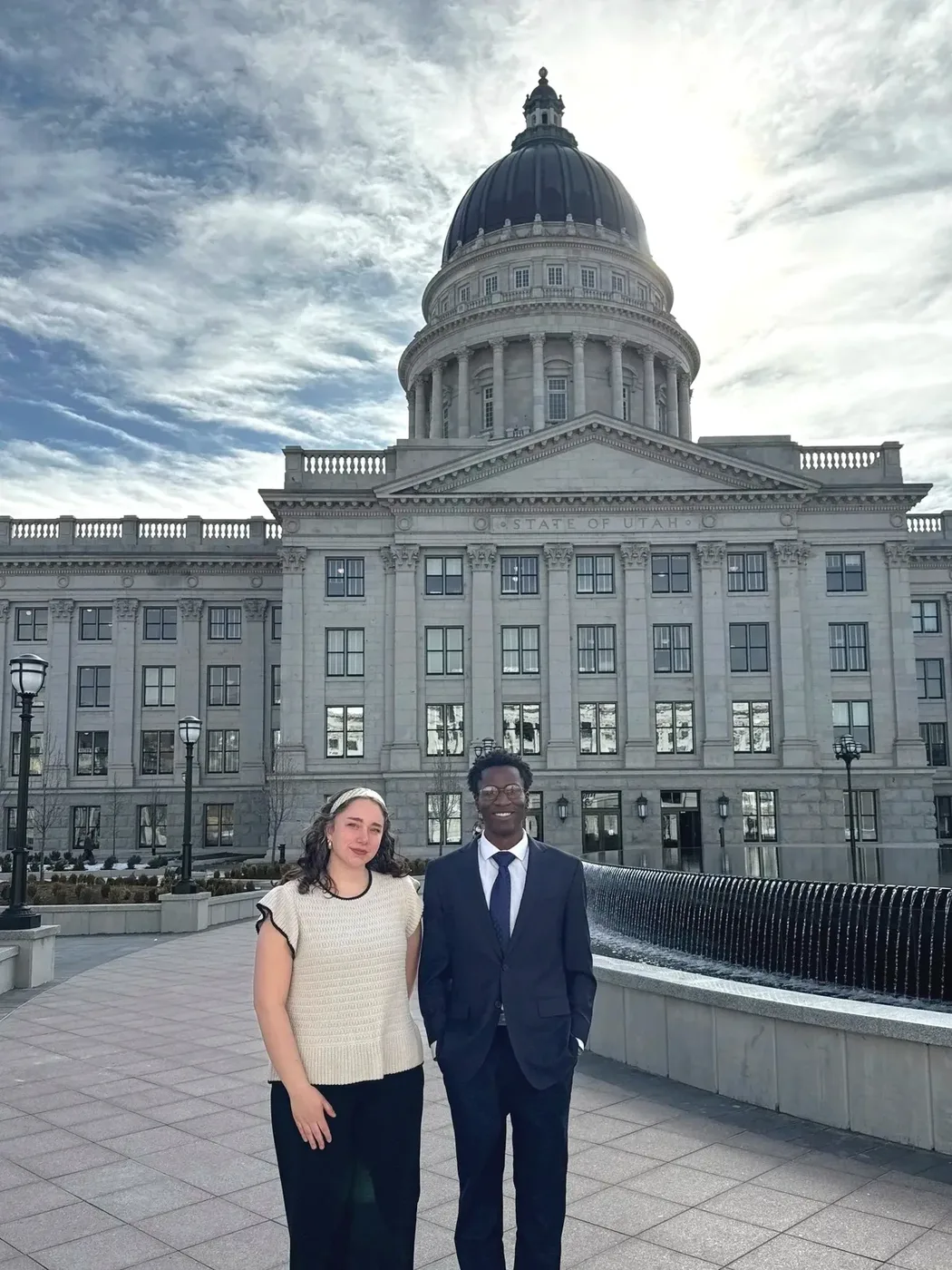
Jasmine Turner & Kefa Abakuki
PolicyLab internship
Learn at the intersection of research and state governance.
PolicyLab interns research complex questions, prepare public-facing resources and observe how scientific evidence informs state decisions.
Students from across Utah’s higher education institutions and all disciplines are welcome to ask about the internship. Contact the team for current openings, timing and participation requirements.
Ask about current internship opportunities.
Ask about the internship ↗Public research
Research built to be used.
PolicyLab interns turn complex policy questions into concise, public-facing resources for Utah legislators, stakeholders, and anyone looking for a clearer understanding of the issues shaping the state.
Issue primers
Clear introductions to policy systems, processes, and emerging issues.
Legislative briefs
Focused analysis prepared around specific legislative questions and topics.
Reports and summaries
Longer-form research and session-level summaries for public reference.
Let’s work together
Connect research, expertise and legislative needs.
Connect with Nucleus to learn more about PolicyLab and ways to engage with the program.
Contact PolicyLab ↗
PolicyLab / Research Library
Research for Utah's policy questions.
Explore issue primers, legislative briefs, and reports developed through PolicyLab. Search by topic, document type, title, or author, then open or download the full PDF.
Available research
8 resources
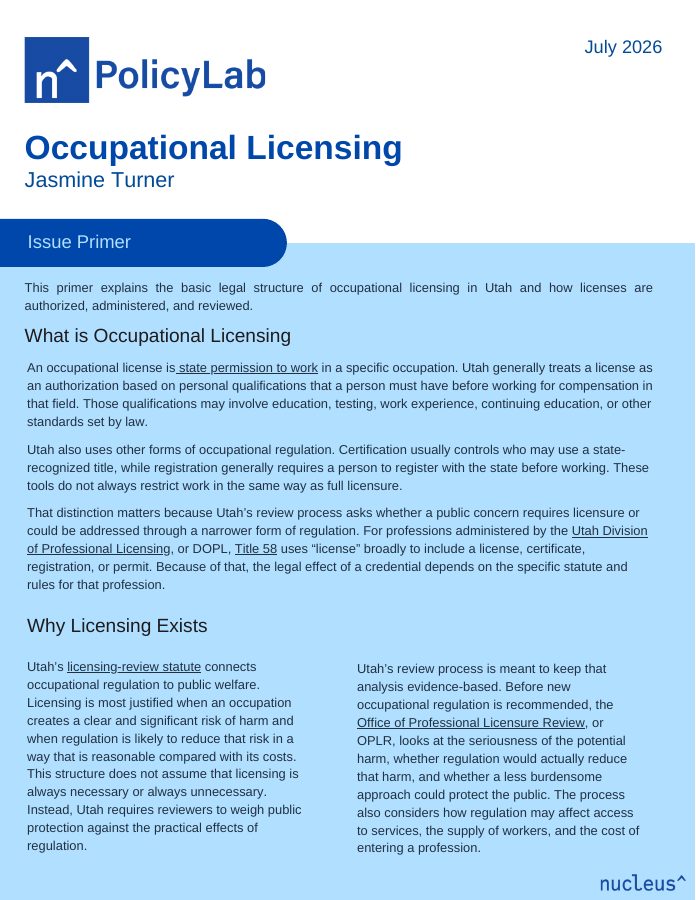
Issue PrimerGovernment & RegulationJuly 2026
Occupational Licensing
An overview of the legal structure of occupational licensing in Utah and how licenses are authorized, administered, and reviewed.
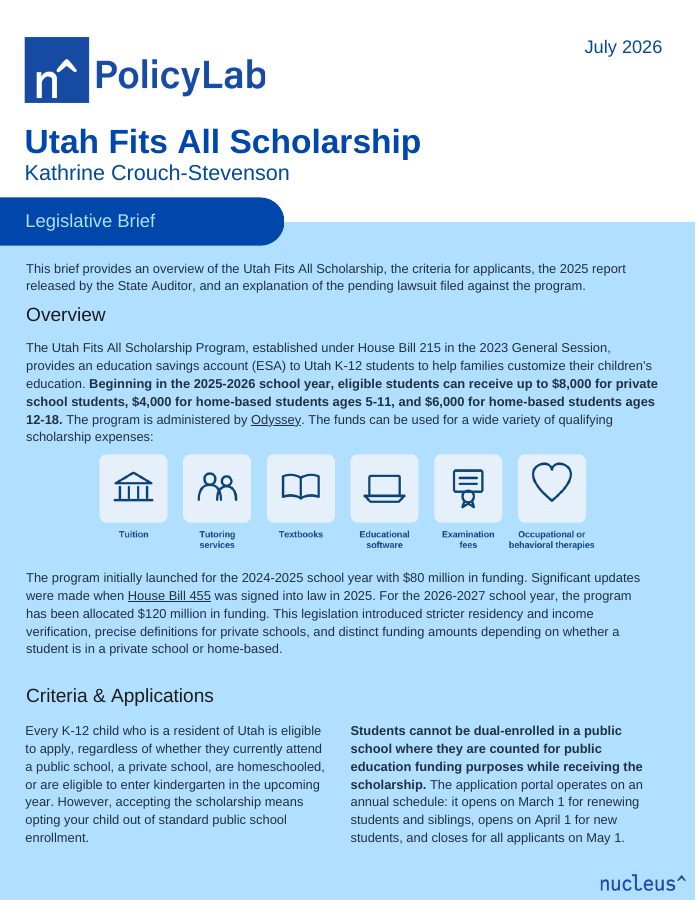
Legislative BriefEducationJuly 2026
Utah Fits All Scholarship
An overview of the Utah Fits All Scholarship, applicant criteria, the 2025 State Auditor report, and the pending lawsuit described in the brief.

Legislative Session SummaryEnergyApril 2026
From Policy to Power: Utah’s Nuclear Energy Agenda
A 2026 legislative session summary focused on nuclear energy policy in Utah.
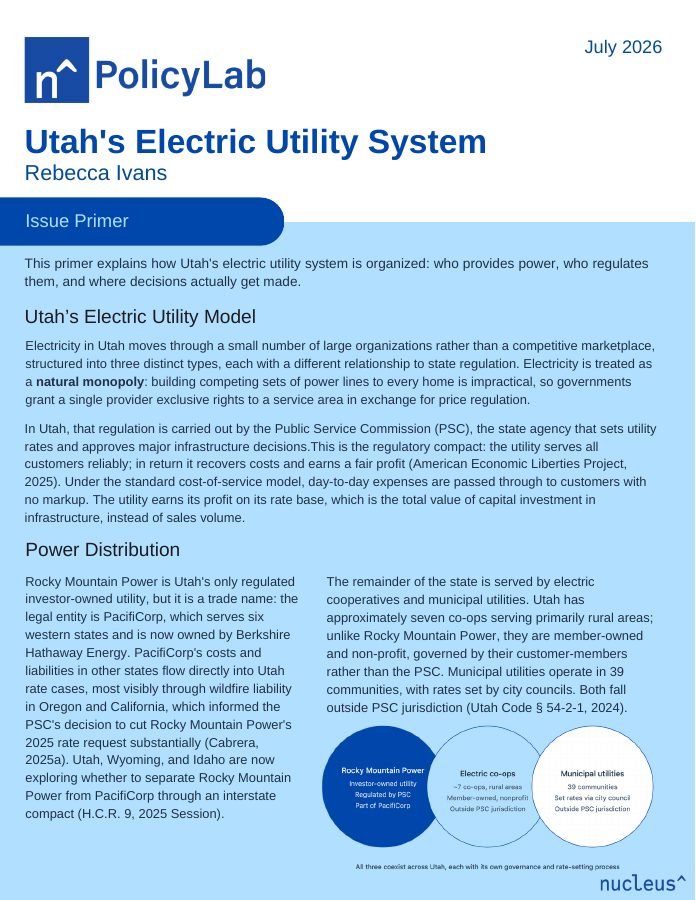
Issue PrimerEnergyJuly 2026
Utah's Electric Utility System
An overview of how Utah's electric utility system is organized, who provides power, who regulates providers, and where decisions are made.
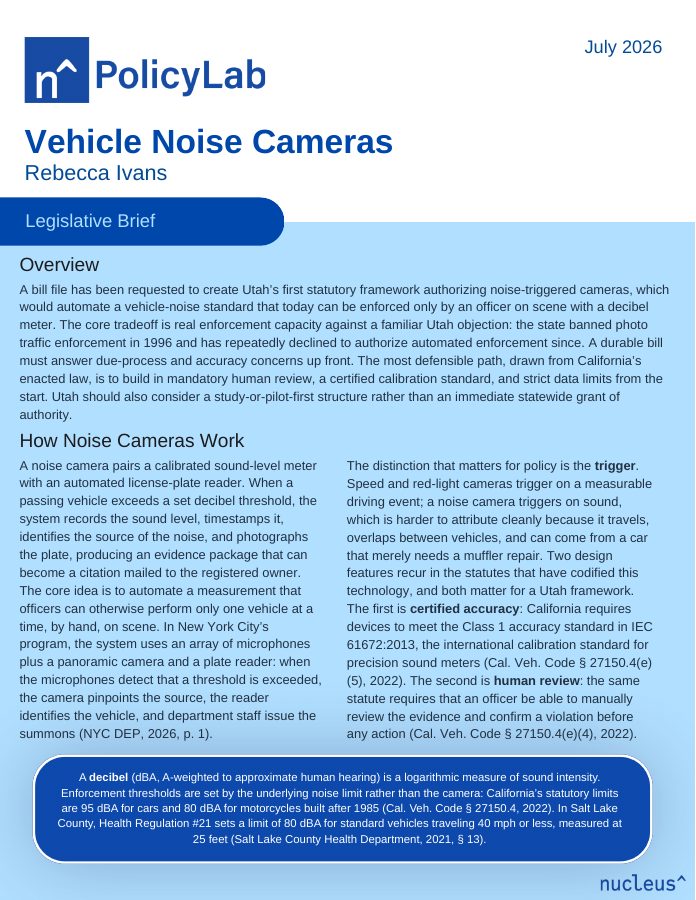
Legislative BriefTransportation & Public SafetyJuly 2026
Vehicle Noise Cameras
An overview of noise-triggered camera systems and the statutory considerations surrounding vehicle-noise enforcement.
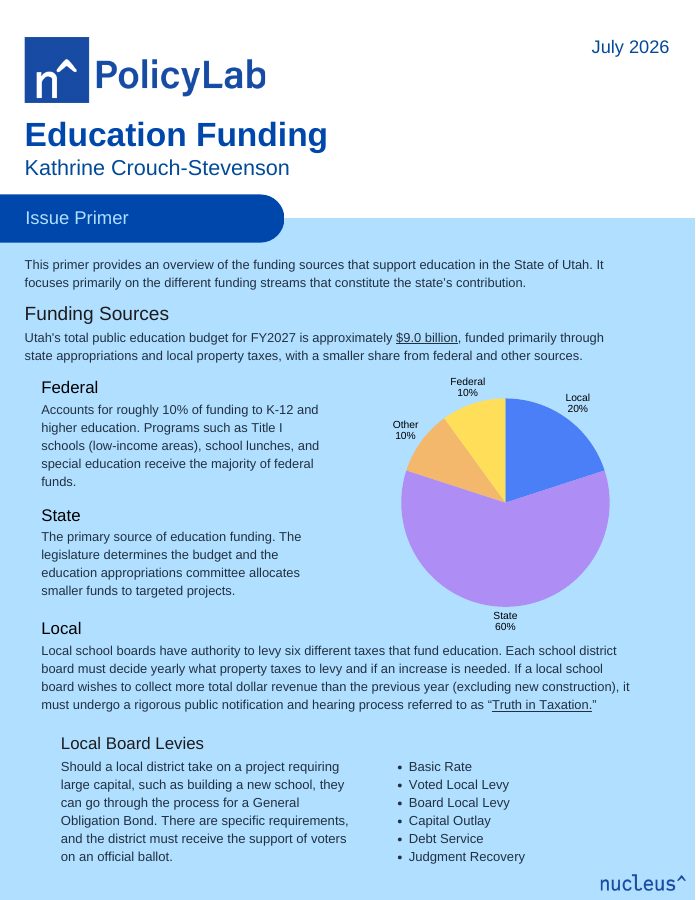
Issue PrimerEducationJuly 2026
Education Funding
An overview of the funding sources that support education in Utah, with a focus on the funding streams that make up the state's contribution.
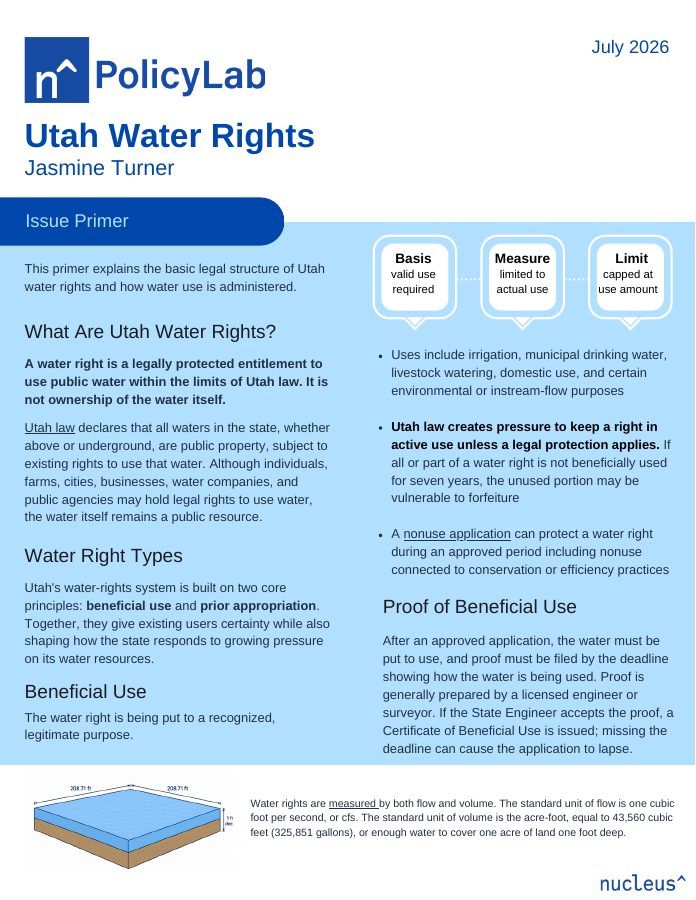
Issue PrimerWater & Natural ResourcesJuly 2026
Utah Water Rights
An overview of the basic legal structure of Utah water rights and how water use is administered.
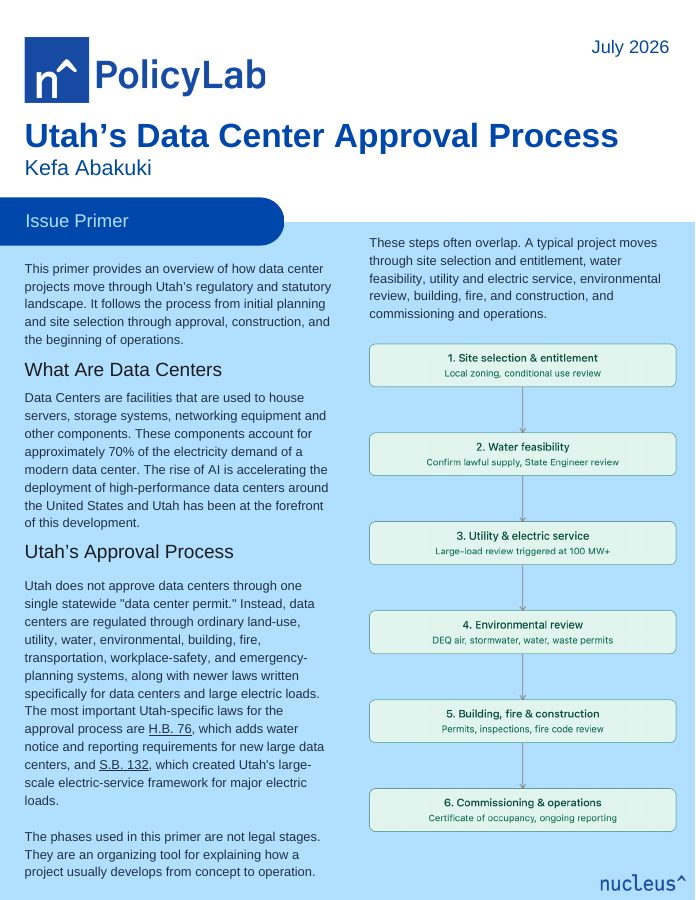
Issue PrimerInfrastructure & TechnologyJuly 2026
Utah’s Data Center Approval Process
An overview of how data center projects move through Utah's regulatory and statutory landscape from planning and site selection through operations.
No resources match those filters.
Try a broader search or reset one of the filters.
The library is designed to expand as new PolicyLab work is published. Categories and filters can grow with the collection without changing the page structure.

Find What You Need
Start with your
next move.
Choose what you need: research support, company-building resources, funding, expertise or investment connections. For a personal introduction, use the Connections Hub.
Five starting points
What would move your work forward?
01 /
I have research
Explore commercialization, industry partners and support for your next milestone.
Explore research support →02 /I’m building a company
Find commercialization support, capital, mentors and a useful network.
Find company resources →03 /I need funding
Compare non-dilutive funding, equity investment and capital connections.
Compare funding options →04 /I need expertise
Connect with researchers, experienced operators, mentors and student talent.
Find expertise →05 /I want to invest
Explore deep-tech companies, founder connections and strategic partnerships.
Explore investment connections →Not sure where to begin?
Start with the question.
Browse the Connections Hub for people and resources, or tell us what you are trying to do.

← Find What You Need
01 / I have research
Give your research a path to the world.
You have a discovery, a new capability or a question worth pursuing. Explore commercialization, find an industry collaborator and understand what it will take to move beyond the lab.
Explore your options ↓Explore your options.
Compare the options below, then contact the program that fits your needs.
Commercialization
Nucleus MarketEdge
Explore a structured path from research to potential customers and startup formation.
Explore MarketEdge →Funding + growth
Nucleus Grow
Get guidance on SBIR/STTR opportunities and the work of taking technology toward market.
Explore Grow →Early-stage capital
Nucleus Fund
Learn about investment focused on Utah deep-tech companies and university-born technologies.
Visit Nucleus Fund ↗Quantum research
Utah Quantum Initiative
Explore Utah’s quantum research capabilities in sensing, photonics, computing and enabling hardware.
Explore quantum research ↗AI research funding
Utah AI Moonshot Program
As part of the Governor’s Pro-Human AI Initiative, the Utah AI Moonshot Program is a statewide competitive funding program supporting ambitious AI research with measurable public benefit.
Explore Utah AI Moonshot →One front door
Let’s find your next step.
You do not need every answer. Start with what you know and what you need.

← Find What You Need
02 / I’m building a company
Build the company. Find your next advantage.
The next milestone may call for capital, technical expertise, a customer conversation or an experienced operator. Find the resources that match the work in front of you.
Explore your options ↓Explore your options.
Compare the options below, then contact the program that fits your needs.
Funding + growth
Nucleus Grow
Get guidance on SBIR/STTR opportunities and the work of taking technology toward market.
Explore Grow →Early-stage capital
Nucleus Fund
Learn about investment focused on Utah deep-tech companies and university-born technologies.
Visit Nucleus Fund ↗Founders + mentors
Boost
Meet founders and mentors at Boost, the October 2, 2026 conference at Utah Tech. See the event page for current details.
Explore Boost →People + partners
Connections Hub
Request an introduction to a researcher, executive or mentor through the Connections Hub.
Open the Connections Hub →Meet the ecosystem
Nucleus Events
Find upcoming conversations, workshops and events across Utah’s innovation community.
Browse the calendar →Quantum industry
Utah Quantum Initiative
Explore commercialization priorities, manufacturing capabilities and industry connections for quantum technologies.
Explore quantum industry ↗Make the first conversation useful
Bring a little context.
- What your company is building and for whom
- Evidence of progress and the next milestone
- The expertise, funding or relationship you need
A few things to know.
Which resource should I try first?
If your need is funding strategy, start with Grow. If you need a person or collaborator, start with the Connections Hub.
Can I explore resources outside my region?
Yes. The finder brings together statewide programs and events. Check each event page for location and participation details.
One front door
Let’s find your next step.
You do not need every answer. Start with what you know and what you need.

← Find What You Need
03 / I need funding
Find capital that fits the work ahead.
Research grants, early-stage investment and investor relationships serve different needs. Start with the milestone you want to reach, then explore the route that fits your company and technology.
Explore your options ↓Explore your options.
Compare the options below, then contact the program that fits your needs.
Funding + growth
Nucleus Grow
Get guidance on SBIR/STTR opportunities and the work of taking technology toward market.
Explore Grow →State funding support
Utah Technology Innovation Fund
Explore state support for eligible SBIR/STTR applicants. Confirm requirements, timing and availability with Grow.
Explore UTIF →Early-stage capital
Nucleus Fund
Learn about investment focused on Utah deep-tech companies and university-born technologies.
Visit Nucleus Fund ↗Quantum coordination
Utah Quantum Initiative
For quantum-focused teams, explore statewide coordination around federal opportunities and research infrastructure.
Explore federal coordination ↗AI research funding
Utah AI Moonshot Program
As part of the Governor’s Pro-Human AI Initiative, the Utah AI Moonshot Program is a statewide competitive funding program supporting ambitious AI research with measurable public benefit.
Explore Utah AI Moonshot →Make the first conversation useful
Bring a little context.
- Company location, stage and technology
- The milestone and intended use of funding
- Relevant technical progress and prior funding
A few things to know.
Is this a funding application?
No. These pages help you find a starting point. Use the application or contact action on the relevant program page.
Does a referral guarantee funding?
No. Each program has its own eligibility, review process and availability. Confirm those details with the program before applying.
One front door
Let’s find your next step.
You do not need every answer. Start with what you know and what you need.
← Find What You Need
04 / I need expertise
The right experience changes what is possible.
Find a researcher, mentor, operator or student team who can bring a new perspective to your work. Start with the problem and the kind of contribution you need.
Explore your options ↓Explore your options.
Compare the options below, then contact the program that fits your needs.
People + partners
Connections Hub
Request an introduction to a researcher, executive or mentor through the Connections Hub.
Open the Connections Hub →Commercialization
Nucleus MarketEdge
Explore a structured path from research to potential customers and startup formation.
Explore MarketEdge →Expert forums
Nucleus Catalysts
Explore focused conversations around emerging priorities and sectors.
Explore Catalysts →Student projects
Nucleus ProLab
Explore a focused project with a student team, guided by faculty and industry mentors.
Discuss a student project →Quantum expertise
Utah Quantum Initiative
Explore research capabilities across physics, engineering, materials and computing, and connect with the initiative.
Find quantum expertise ↗Make the first conversation useful
Bring a little context.
- The expertise or discipline you are seeking
- A defined question or scope of work
- Your timeline and preferred way to collaborate
A few things to know.
What if I do not know which institution to contact?
The Connections Hub is a starting point for exploring researchers and other people across the ecosystem.
Is a student project the same as hiring a consultant?
No. ProLab connects academic learning with a defined partner challenge. Ask about project scope, timing and fit before planning around a team.
One front door
Let’s find your next step.
You do not need every answer. Start with what you know and what you need.

← Find What You Need
05 / I want to invest
Get closer to Utah’s next generation of companies.
Explore the Nucleus Fund, meet founders and researchers, or start a conversation about the sectors and stages that interest you. Useful relationships begin with a clear investment focus.
Explore your options ↓Explore your options.
Compare the options below, then contact the program that fits your needs.
Early-stage capital
Nucleus Fund
Explore investment focused on Utah deep-tech companies and university-born technologies.
Visit Nucleus Fund ↗Global connections
Nucleus Global
For organizations exploring international collaboration, Nucleus Global is a starting point for discussing market access and relationships in Utah.
Discuss global opportunities ↗Capital + opportunity
Nucleus Exchange
For investors and project owners, Nucleus Exchange connects capital with Utah opportunities in technology, real estate and infrastructure.
Explore Exchange participation ↗Quantum partnerships
Utah Quantum Initiative
Explore Utah’s quantum strategy and connections among research, companies, manufacturers and capital.
Explore quantum partnerships ↗Make the first conversation useful
Bring a little context.
- Your sectors and stages of interest
- Your preferred role: investor, operator or strategic partner
- The kind of introduction you would find useful
A few things to know.
Where can I learn about the Fund?
The Fund overview explains its focus and links to its dedicated website and portfolio.
Can an organization participate beyond investing?
Explore strategic partnerships for research, talent, convening and collaboration opportunities.
One front door
Let’s find your next step.
You do not need every answer. Start with what you know and what you need.

← Find What You Need
Nucleus Fund
Capital for ideas ready to move.
Nucleus Fund invests in early-stage Utah deep-tech ventures emerging from the state’s universities and research institutions. Explore its focus, portfolio and application process.
Visit the Nucleus Fund website ↗Understand the fit
A useful place to begin.
For founders
Start with your technology, the problem it addresses and the evidence behind your next milestone. Review the Fund’s application before preparing a submission.
For investors and partners
Explore the portfolio and investment focus to understand the companies and technologies the Fund supports.
Beyond the check
The Fund connects capital with mentorship, networks and commercialization resources.
Prepare for the conversation
What to bring.
- Company and technology overview
- Technical progress and connection to Utah
- Funding milestone and intended use of capital
Keep exploring
Connected resources.
Funding + growth
Nucleus Grow
Get guidance on SBIR/STTR opportunities and the work of taking technology toward market.
Explore Grow →
← Find What You Need
Nucleus ProLab
Real challenges. Student ingenuity.
ProLab connects students from Utah’s public colleges and universities with companies, nonprofits and public agencies through short-term, credit-earning projects guided by faculty and industry mentors.
Understand the fit
A useful place to begin.
Bring a focused project
For example, ask a student team to research customer needs, compare approaches or explore a prototype. Agree on a focused deliverable with the program team.
Connect learning with useful work
Consider how research, analysis or a prototype could help your organization while giving students practical experience.
Discuss fit before committing
Ask about timing, faculty involvement and project expectations before setting a delivery schedule.
Prepare for the conversation
What to bring.
- A short description of the challenge
- The deliverable you would find useful
- A partner contact and proposed timeframe
Keep exploring
Connected resources.
Research expertise
Connections Hub
Need a researcher, mentor or experienced operator for your project?
Request an introduction →Research commercialization
Nucleus MarketEdge
Explore customers, market fit and potential commercial applications for research.
Explore MarketEdge →Quantum workforce
Utah Quantum Initiative
Explore the skills, education priorities and career pathways shaping Utah’s future quantum workforce.
Explore quantum workforce ↗Nucleus Catalysts
Expertise for Utah’s next challenges.
Nucleus Catalysts are invite-only groups of subject matter experts convened around emerging sectors, statewide opportunities and complex challenges that benefit from sustained cross-sector expertise.
The model
Expertise organized around action.
Each Catalyst brings together research, industry and public-sector expertise around a defined topic. Members share evidence, identify priorities and develop opportunities to work together.
01Subject matter expertsParticipants are selected for relevant expertise and experience.
02Invite onlyEach Catalyst is intentionally composed around the needs of its focus area.
03Outcome orientedThe work is designed to move beyond discussion toward useful statewide action.
2026 Catalysts
Focus areas for 2026.
Each Catalyst focuses on a distinct area where coordinated expertise can help Utah move faster, surface opportunities and strengthen statewide capacity.
AI Research
OutcomeMoonshot launched
Commercialization
OutcomeProviding statewide support
Quantum
OutcomeExecutive Order
Utah Quantum Initiative ↗Innovation Districts
2026 Catalyst
Neurotech
2026 Catalyst
Innovation in Education
2026 Catalyst
Why Catalysts
Build shared understanding. Create the conditions for action.
Some challenges require expertise from several institutions and sectors. Catalysts create a forum for that sustained work. Participation is by invitation; organizations with relevant expertise can contact Nucleus to discuss collaboration.

Convergence Corridor
One state.
Connected strengths.
Explore the universities, research facilities, defense assets and public institutions that support innovation across Utah. Use the map and directory to find a resource and visit its official site.
A statewide network
Find expertise across Utah.
The Convergence Corridor links Utah’s research, industry, talent, capital and public assets—from northern Utah through the Wasatch Front to southern and rural communities.
Use the map below to explore universities, labs, research facilities, defense assets and statewide infrastructure. Locations are shown for navigation and discovery; select a resource to visit its official site.
Explore the corridor
Find the people, places and capabilities already here.
Search the network or filter by resource type. Select any marker or resource to learn more and follow the official link.
University
Research + lab
Defense + aerospace
State + innovation infrastructure
The statewide advantage
Connection lets every region do more of what it does best.
A researcher in Logan, a company in Salt Lake City and a partner in St. George can use the corridor to find expertise, facilities and support beyond their immediate region.
Connect across the corridor →
THE POINT · DRAPER, UTAH · PLANNED OPENING 2029+
Convergence
Point.
“Utah’s greatest advantage has always been our people and what they can accomplish together. The opportunity before us is to connect them in ways we never have before.”
— Governor Spencer Cox
01 / The vision
A place where Utah builds together.
Convergence Point is planned as a shared front door for Utah’s innovation community at The Point in Draper.
Researchers, students, founders, industry leaders, investors and public partners will have a place to find one another, test ideas, demonstrate what works and move promising work toward use. It is a physical hub for a statewide network, connecting people and capabilities well beyond one building.
ConnectCollaborateDemonstrateBuild
02 / The place
A new home for
what comes next.
Explore the architectural vision for Convergence Point. Select any image for a closer look.
Inside Convergence Point
Work, learning, gathering and residential spaces envisioned for the campus.
Architectural renderings illustrate the current design vision and may change as the project develops.
03 / Solve big problems
Bring the right people
to the same problem.
Innovation Impact Labs are envisioned as cross-sector teams working on challenges such as housing, water and future-proofing our economy. The proposed model connects research with practical testing and implementation.
More ways to build.
Connect research, industry and public partners around new approaches to housing affordability and delivery.
Secure our future.
Bring water expertise, technology and practical implementation together around Utah’s long-term needs.
Future-proof economy
Connect research, industry and workforce partners to help Utah businesses and workers adapt, compete and create new opportunities.
04 / The future of education
Learn by working on what’s next.
A place for students, educators and practitioners to learn together through real challenges.
The education vision includes hands-on projects through Nucleus ProLab, spaces for design and learning, and a proposed home for Sandbox. Planned student housing would support participation from regional institutions. These uses are part of the developing campus concept.
Discuss participation ↗
05 / Innovation hubs
Give emerging companies room to grow.
Planned incubator spaces would bring researchers, founders and industry teams together around Utah’s priority sectors, with access to collaborators and practical support.
PROPOSED FOCUS AREAS
06 / Global connections
Connect Utah to ideas everywhere.
Convergence Point aims to connect Utah with innovation hubs around the world. The organizations shown are examples informing the vision and prospective connections; partnerships have not been announced here.
PARISStation FDUBAIDubai Future FoundationINDIAT-HubEUROPEEurope Tech FoundationSOUTH KOREAIncheon Startup Park
07 / Resources
The resources to move ideas forward.
Convergence Point is designed to make support visible and accessible, from first conversations through prototypes, partnerships and investment.
Make & test
Planned prototype lab, design thinking suites, demonstration gallery and production and broadcast studio.
Meet & share
A public entry hall, flexible educational theater and spaces for events, showcases and pitch conversations.
Find support
Resource center, venture support, investor connections and a planned Policy Innovation Lab where students and experts work together on solutions.
08 / The Point district
At the heart of Utah’s innovation community.
Convergence Point is planned within The Point in Draper, the transformation of roughly 600 acres of state-owned land into a mixed-use innovation community. The Point’s first phase covers approximately 100 acres and brings together an innovation district with homes, workplaces, shops, open space and connections to transit and regional trails.
Explore The Point’s development plan ↗
09 / Project timeline
From vision to a working place.
- 2026
Design
Planning and design development; preparation for construction.
- 2027–2028
Construction
Building the spaces and infrastructure for the campus vision.
- 2029+
Opening
Targeted opening and the start of on-site programming.
Planned opening: 2029+. This indicative schedule and project scope may change as design and delivery plans develop.
10 / Project collaborators
Built through collaboration.
Organizations identified by the project team as design and delivery collaborators.






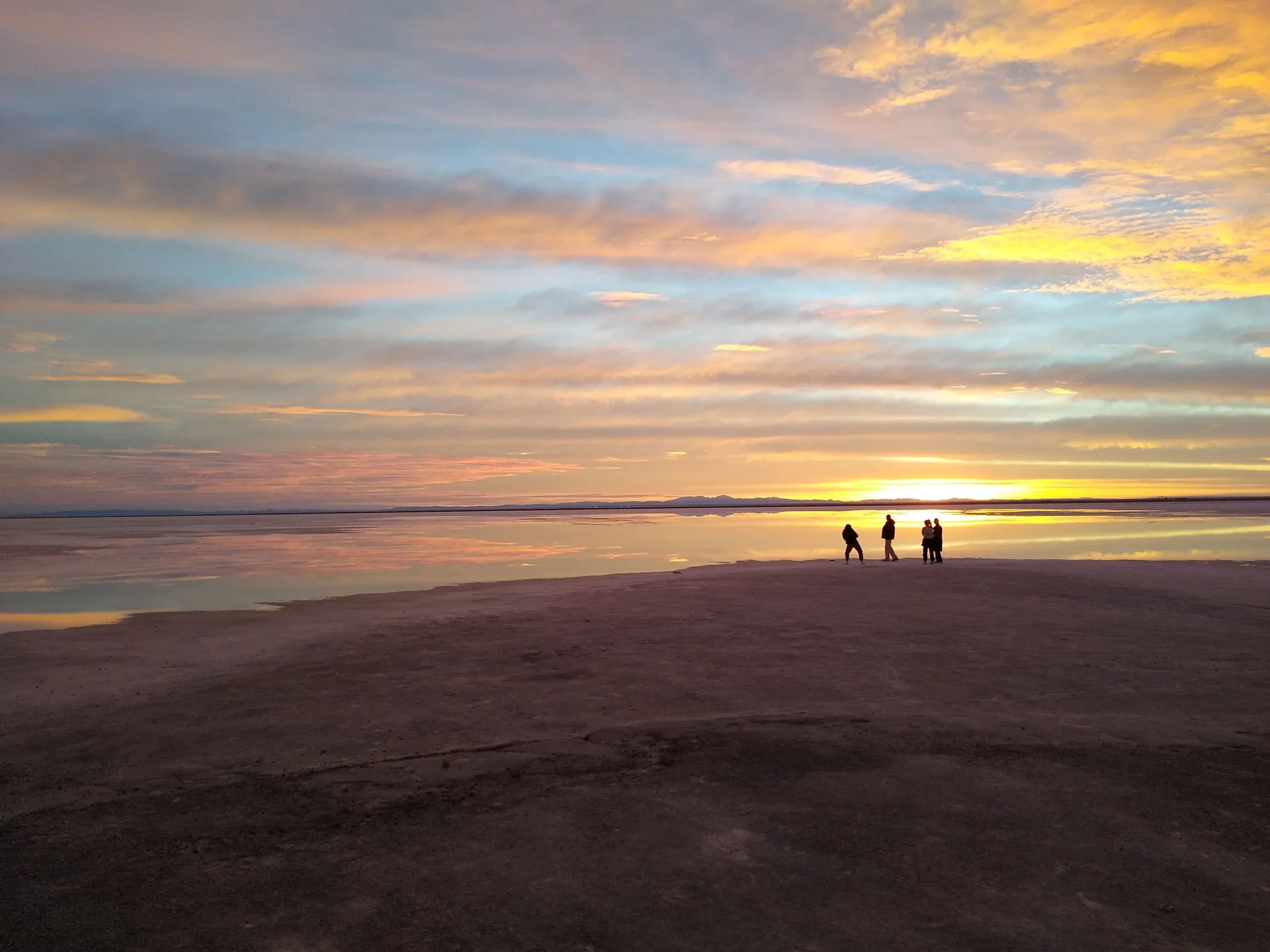
The Nucleus Institute
Newsroom.
Stories, announcements and progress from across Utah’s innovation community.
All stories
News & Events
Meet. Learn. Build.
Find your next connection across Utah’s innovation community.
Annual convening Explore the event →Founders + builders
 Explore the event →Pro-human AIUtah AI SummitVisit the summit website ↗
Explore the event →Founders + buildersExplore the event →Pro-human AIUtah AI SummitVisit the summit website ↗Upcoming events
All times shown in Mountain Time.
Swipe across the calendar to see the full week.
State of Innovation · 2026
Where Utah aligns on the future of its innovation economy.

One state. Shared priorities.
A place to shape
what comes next.
State of Innovation brings leaders from industry, government and higher education together to examine Utah’s innovation economy and define the priorities that will move it forward.
Through shared research, statewide perspectives and working conversations, the event connects the people who can turn those priorities into action.
Thank you for joining us in 2026.
To our speakers, panelists, vendors, partners and attendees: thank you for being part of the conversation. We look forward to seeing you in 2027. The next event date and registration details will be announced here.
To our speakers, panelists, vendors, partners and attendees: thank you for being part of the conversation. We look forward to seeing you in 2027. The next event date and registration details will be announced here.
Research + perspective
The 2026 State of Innovation Report.
Explore the data, gaps and opportunities shaping Utah’s innovation economy—and the collaboration needed for its next chapter.
Download the report ↓State of Innovation eventsFull calendar →
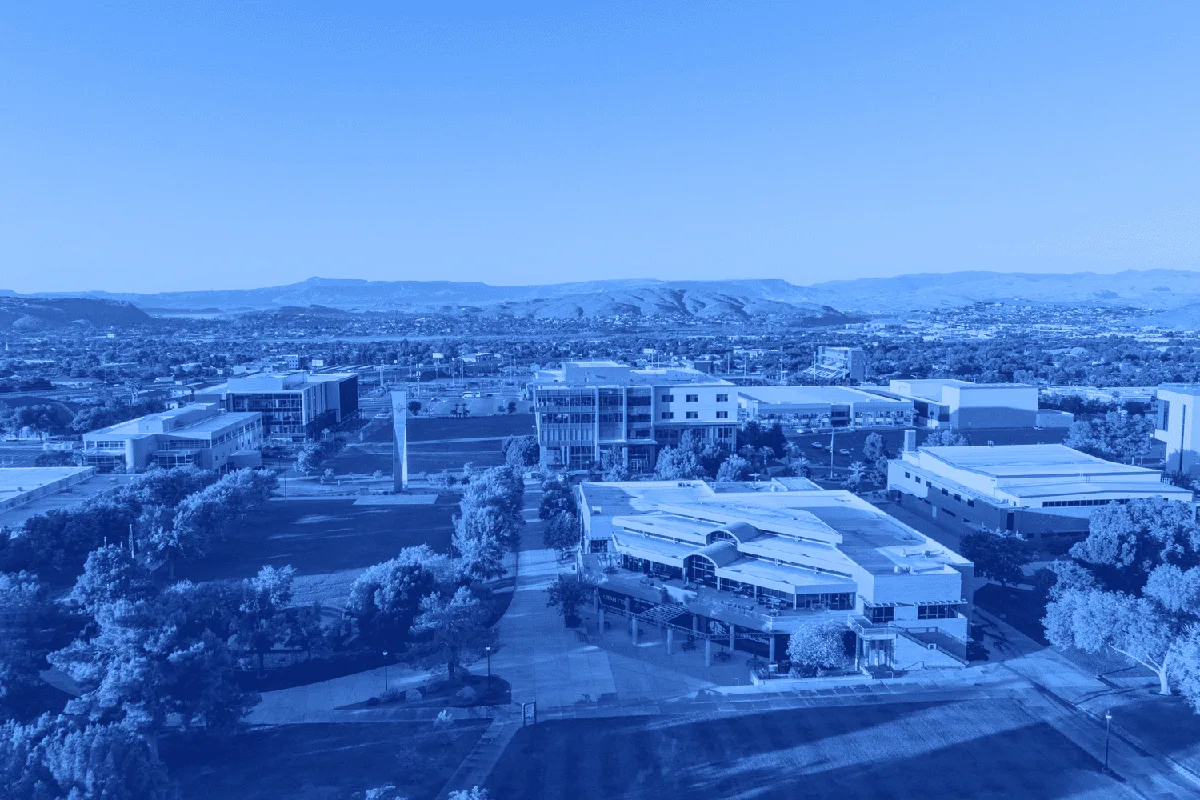
October 2, 2026 · Southern Utah
Built for
what’s next.
Big ideas. Real experience.
The people to help you go further.
Jeffrey R. Holland Centennial Commons & Library
Utah Tech University · St. George
Built for builders
Ideas, experience
and people to
help you grow.
Boost at Utah Tech brings Southern Utah’s founders and builders closer to the mentors, knowledge and capital that move companies forward.
Hear directly from entrepreneurs, join practical workshops, and connect one-to-one with experienced mentors. Whether you’re building a company, exploring an idea or planning your next step, come ready to participate.
Founders · Mentors · Investors · Workshops · Real-world playbooks
READY FOR LIFTOFF.
BOOST / IN MOTION
October 2, 2026Mountain Time
The day at a glance.
8:15 a.m. — Check-in
Check-in and registration.
8:45 a.m. — Welcome to Boost
Tyler Jennings welcomes guests to Boost in Southern Utah.
9:00 a.m. — Welcome to Utah Tech
Hear from Brian Sandusky, Vice President of Enrollment and Marketing at Utah Tech University.
9:05 a.m. — The Convergence Corridor
Angela Smith, COO of The Nucleus Institute, discusses the future of business in Utah.
9:15 a.m. — All in on building the future with Clint Reid
Clint Reid, founder and CEO of Zonos, shares lessons from building the company.
9:30 a.m. — Building an aerospace company with Brian McCann
Brian McCann, CEO of Intergalactic, shares his experience building an aerospace company in Southern Utah.
9:45 a.m. — Practical entrepreneurship with Kevin Tallman
Kevin Tallman, CEO of Mango Voice, shares lessons from the challenges of building an early-stage startup.
10:00 a.m. — Break
10:05 a.m. — Careers that keep talent in St. George
Jeff Butler leads a discussion on building a company or career in Southern Utah.
10:25 a.m. — How to get dangerous with AI
A practical workshop from Leland on using AI. See the registration page for current speaker details.
10:45 a.m. — Build software without a technical co-founder
Matt Sutherland and Peter Fuller explore how to start building software without a technical co-founder.
11:05 a.m. — Break
11:10 a.m. — Investing in Utah’s future with Craig Earnshaw
Craig Earnshaw, technology founder, angel investor and adjunct professor, shares advice for Utah’s future founders.
11:30 a.m. — Building Southern Utah’s tech community with Isaac Barlow
Isaac Barlow, founder of busybusy and Managing Partner of Tech Ridge, discusses creating higher-wage opportunities and keeping talent in Southern Utah.
11:50 a.m. — Building a consumer brand with Misty Kirby
Misty Kirby, co-founder of Paparazzi Jewelry, discusses building a consumer brand while keeping products affordable.
12:10 p.m. — Creating an everyday company with Nicole Robison
Nicole Robison, founder of Swig, shares her experience building a company customers return to every day.
12:40 p.m. — Lunch and group photo
Take a break for lunch and a group photo.
1:00 p.m. — Mentoring sessions
Meet experienced founders, operators and investors. See the registration page for mentoring sign-up details.
3:00 p.m. — Closing and raffle
Close the day with a raffle and final remarks.
Agenda subject to change. Check the registration page for the latest event information.
People you’ll hear fromBoost at Utah Tech
The speakers.

Tyler Jennings
Director of Entrepreneurship · GOED

Nicole Robison
Founder · Swig

Clint Reid
Founder & CEO · Zonos

Brian McCann
CEO · Intergalactic

Kevin Tallman
CEO · Mango Voice

Misty Kirby
Co-Founder · Paparazzi Jewelry

Angela Smith
COO / Managing Director · Nucleus Institute
Isaac Barlow
Managing Partner · Tech Ridge

Craig Earnshaw
Investor / Mentor · Eaglewood Capital
Learn from experience
Meet the mentors.
Connect with people who have built companies, hired teams, raised capital and taken ideas to market. Mentoring sessions begin at 1 p.m.; see registration information for sign-up details.
Shaun RitchieJeff ButlerLauren MuellerGil BentonLesly GaonaDeanna MasonSeth SaundersDavid M NilssonDustin GarrEric PedersenNick EnceOwen WestJake CorkinJohn BowlerJoe MakstonDan StewartJason MyersPeter FullerBryson DespainRon CraigMatt Kearl
Our Team
People connecting Utah.
Our team brings experience in entrepreneurship, investment, higher education, research and public service to Nucleus’s work across Utah.
LeadershipDirection + operations
JM
Jefferson Moss
Chief Executive Officer · Board Member
AS
Angela Smith
Chief Operating Officer
KW
Kristin Wihera
Director of Fund Operations
DD
Dylan Doty
Director of Nucleus Grow
CD
Cam Dionne
Director of Marketing, PR, and Events
BB
Briann Bardsley
Administrative Manager
JB
Jackie Borget
Community Outreach Manager
AD
Alex Dalpe
Program Manager
TN
Tara Nielson
Program Manager
HC
Hannah Cancino
Manager of Partnerships and Business Development
RG
Rebecca Gerth
Program ManagerHow we work
A small team with a statewide mandate.
Nucleus is built to operate across institutional and regional lines. The team works with universities, founders, investors, industry leaders, communities and public partners to make expertise, capital and opportunity easier to reach across Utah.
ConveneEducateFundStatewide
Board of DirectorsStatewide leadership
 Hover for bio
Val Peterson
Board Chair Hover for bio
Jefferson Moss
Board Member Hover for bio
Aaron Skonnard
Board Member Hover for bio
Kirk Cullimore
Board Member Hover for bio
Cydni Tetro
Board Member Hover for bio
Troy D'Ambrosio
Board Member Hover for bio
Vic Hockett
Board MemberNucleus Fund Investment CommitteeInvestment oversight
Experienced oversight for the Nucleus Fund investment process.
The Nucleus Fund Investment Committee is responsible for overseeing the Fund’s investment process and bringing experienced perspectives to investment decisions.
 Hover for bio
Keith Marmer
Investment Committee Hover for bio
Tom Ngo
Investment Committee Hover for bio
Adam Robertson
Investment Committee Hover for bio
Gary Williams
Investment CommitteeDiligence AdvisorsSpecialized investment support
Additional expertise supporting sound investment decisions.
Nine Diligence Advisors support the Nucleus Fund investment process with additional perspective and subject-matter expertise.

Justin Brunson
Diligence Advisor
James Campbell
Diligence Advisor
Paul Campbell
Diligence Advisor
Jonathan Johnson
Diligence Advisor
Ciara Kennedy
Diligence Advisor
Craig Miller
Diligence Advisor
Charles Musgraves
Diligence Advisor
Geremy Mustard
Diligence Advisor
David Wingate
Diligence AdvisorWork with Nucleus
Start with the right conversation.
Whether you are building, researching, investing or trying to solve a challenge, our team can help you find a useful starting point.
Connect with Nucleus →Connections Hub
Find the people who can help.
Tell us what you are working on and the expertise you need. Start with a researcher, executive or mentor connection, or ask Nucleus where to begin.
What kind of connection would help?
Each network welcomes people offering expertise and people looking for it. Choose the form that best fits the support you want to give or receive.
Research + technical expertise
Researcher network
Connect research expertise with small businesses working through scientific or technical challenges.
For researchers
Explore opportunities to apply your work beyond the lab, collaborate with companies and help move ideas toward real-world use.
For small businesses
Find research expertise and technical insight to help investigate a question, evaluate an approach or develop an idea.
Choose this for
Research collaboration, technical questions or specialized expertise.
Business + leadership
Executive network
Connect experienced leaders with small businesses that need business or operational expertise.
For executives
Put your experience to work with a Utah business that could benefit from your leadership, operational knowledge or industry background.
For small businesses
Connect with an experienced leader to help address business challenges, strengthen operations or plan for growth.
Choose this for
Leadership, business operations or company growth.
Guidance + mentorship
Mentor network
Connect founders, students and emerging professionals with mentors who can share practical guidance.
For mentors
Share practical knowledge as an experienced operator, founder or industry expert supporting Utah’s next generation of builders.
For mentees
Find guidance and real-world perspective as you navigate decisions, develop your skills or move an idea forward.
Choose this for
Practical advice, professional development or a fresh perspective.
Public resource directory
Find support across Utah.
Browse programs, organizations and places that support Utah researchers, founders and growing companies.
| Organization / program | Support | Location | Learn more |
|---|---|---|---|
| Brigham Young University | Universities & Talent Research university with strengths spanning engineering, science, entrepreneurship, business and applied research. |
Provo | Visit website ↗ |
| Convergence Corridor | Places & Infrastructure Explore universities, labs and other resources across Utah. |
Statewide | Explore → |
| Convergence Point at The Point | Places & Infrastructure Nucleus's future physical front door at The Point—built for research translation, collaboration, demonstration, company building and public engagement. |
Draper | Explore → |
| Falcon Hill Aerospace Research Park | Defense & Aerospace A large public-private aerospace research park at Hill Air Force Base connecting federal missions with commercial development. |
Hill AFB / Davis County | Visit website ↗ |
| Hill Air Force Base | Defense & Aerospace A major Air Force Materiel Command installation supporting aircraft sustainment, testing, logistics and national-security missions. |
Northern Utah | Visit website ↗ |
| Huntsman Cancer Institute | Research & Labs A nationally recognized cancer research and treatment center at the University of Utah, connecting discovery, clinical research and patient care. |
Salt Lake City | Visit website ↗ |
| Institute of Land, Water, and Air | Research & Labs Utah State University institute connecting research, data and expertise around Utah’s land, water and air resources. |
Logan | Visit website ↗ |
| MarketEdge | Commercialization Explore potential customers, market fit and startup formation. |
Statewide | Explore → |
| Miller Advanced Research & Solutions (MARS) Center | Research & Labs Weber State-led advanced manufacturing and aerospace research center focused on high-temperature materials, pilot-scale manufacturing and workforce development. |
Clearfield · Falcon Hill | Visit website ↗ |
| Nucleus Fund | Funding & Capital Explore the Fund’s investment focus, portfolio and application. |
Statewide | Visit website ↗ |
| Nucleus Grow | Grants & SBIR/STTR Get help identifying opportunities and preparing SBIR/STTR proposals. |
Statewide | Explore → |
| PolicyLab | Research & Labs Read public primers, legislative briefs and research summaries. |
Statewide | Explore → |
| ProLab | Student Projects Discuss a focused project with student teams and mentors. |
Statewide | Explore → |
| Salt Lake City International Airport | Places & Infrastructure Utah's primary global aviation gateway, providing nonstop connectivity for companies, talent, research partners and visitors. |
Salt Lake City | Visit website ↗ |
| Silicon Slopes | Places & Infrastructure A major statewide technology community centered along the Wasatch Front, connecting founders, companies, investors and talent. |
Lehi | Visit website ↗ |
| Snow College | Universities & Talent Central Utah college providing hands-on education, workforce pathways and research opportunities across rural communities. |
Ephraim | Visit website ↗ |
| Southern Utah University | Universities & Talent Southern Utah university with hands-on education, entrepreneurship and applied research supporting the region's growing economy. |
Cedar City | Visit website ↗ |
| Space Dynamics Laboratory | Research & Labs A university-affiliated research center advancing satellites, sensors, autonomous systems, cybersecurity and national-security missions. |
North Logan | Visit website ↗ |
| State Capitol + Governor's Office of Economic Opportunity | Places & Infrastructure State leadership, economic-development and public-sector partners that help connect innovation priorities, resources and statewide implementation. |
Salt Lake City | Visit website ↗ |
| University of Utah | Universities & Talent Utah's flagship research university, with broad strengths across engineering, health, science, entrepreneurship and technology commercialization. |
Salt Lake City | Visit website ↗ |
| Utah AI Moonshot | Research & Labs Explore Utah’s AI Moonshot initiative, priorities and resources. |
Statewide | Explore → |
| Utah FORGE | Research & Labs Department of Energy-supported underground field laboratory for developing, testing and accelerating enhanced geothermal-system technologies. |
Near Milford | Visit website ↗ |
| Utah Quantum Initiative | Research & Labs Nucleus partners on this statewide initiative connecting quantum research, industry and talent. |
Statewide | Visit website ↗ |
| Utah San Rafael Energy Lab | Research & Labs State energy research facility providing space, equipment and staff for advanced nuclear, energy, manufacturing and sustainability research. |
Orangeville / Emery County | Visit website ↗ |
| Utah SBDC Network | Business Support Find business consulting, training and a local Small Business Development Center. |
Statewide | Visit website ↗ |
| Utah State University | Universities & Talent Land-grant and space-grant university with statewide research, engineering, agriculture and commercialization capabilities. |
Logan | Visit website ↗ |
| Utah Tech University | Universities & Talent Polytechnic-focused university serving one of Utah's fastest-growing regions with applied learning, entrepreneurship and technology programs. |
St. George | Visit website ↗ |
| Utah Valley University | Universities & Talent Large teaching university with real-world learning, engineering, technology, business and workforce connections in Utah County. |
Orem | Visit website ↗ |
| Utah Water Research Laboratory | Research & Labs Utah State University's major water and environmental research facility, with hydraulics, water-quality and intelligent-water-system capabilities. |
Logan | Visit website ↗ |
| Weber State University | Universities & Talent Northern Utah university with strong workforce, engineering, applied science and industry-connected programs. |
Ogden | Visit website ↗ |
| World Trade Center Utah | Export & International Connect with programs, services and networks for international business growth. |
Statewide | Visit website ↗ |
No resources match your search. Try another keyword or clear the filters.
Join the directory
Help Utah find your resource.
Does your organization support Utah researchers, founders or growing companies? Request a listing through the resource intake form. Include your organization, website, services, audience and Utah locations.
Requests go to the Nucleus team for review before a listing is added.
n^
Nucleus StaffPublishing + staff workspace
Internal access
Staff login.
Sign in with your individual staff account to manage newsroom stories and the PolicyLab Research Library.
Access is limited to authorized Nucleus employees. Contact your site administrator for an invitation.
N
Nucleus StaffNewsroom
Stories
Write, review and publish stories on the Nucleus website.
Connections Hub
Review queue
Human review remains the decision point for every introduction.
Connection requests
| Request | Pathway | Region | Status |
|---|
↔Select a connection request
Review context, potential matches and next actions here.
Resource Directory
Listing review
Verify Utah presence, service relevance and organization legitimacy before publishing.
PolicyLab
Research Library
Add, edit, publish, unpublish, or remove resources shown in the public PolicyLab Research Library.
Audit trail
Recent activity
A lightweight record of staff decisions and consent milestones.
✓
Executive candidate shortlisted
REQ-1046 · 18 minutes ago · C. Reviewer
REQ-1046 · 18 minutes ago · C. Reviewer
✓
Research request moved to consent
REQ-1044 · 2 hours ago · A. Reviewer
REQ-1044 · 2 hours ago · A. Reviewer
•
Additional information requested
REQ-1042 · Yesterday · J. Reviewer
REQ-1042 · Yesterday · J. Reviewer
✓
Resource listing approved
DIR-221 · Yesterday · C. Reviewer
DIR-221 · Yesterday · C. Reviewer
Updated.
Connect with Nucleus
Start the conversation.
Tell us what you’re working on and what would help. We’ll direct your inquiry to the appropriate Nucleus team.
AI that serves
humans.
Not the other way around.
Notice: The Utah AI Moonshot NOFO was updated on 8/12/2026. Please review the current version before applying.
Utah AI Moonshot Program
Funding Pro-Human AI Research to Improve Life in Utah
As part of the Governor’s Pro-Human AI Initiative, the Utah AI Moonshot Program is a statewide competitive funding program supporting ambitious AI research with measurable public benefit. Through three funding pathways, the program invests in projects that address Utah’s priorities through collaboration between higher education, industry, and government.
The Utah AI Moonshot Program is funded through the Higher Education Research Funding Pilot (HERFP). The program is administered in partnership with the Utah System of Higher Education, and the Nucleus Institute.
$5 Million
Research Funding
3
Funding Pathways
12+
Awards
6-24 Months
Projects
Announcement from Governor Cox
Utah AI Moonshot Core Tenets
Utah-Centric
Projects should address challenges that matter to Utah and create lasting value for the state. Competitive proposals will leverage Utah's unique strengths while delivering outcomes that benefit Utah's communities, economy, or public institutions first. Projects will be led and submitted by a USHE Institution.
Economic Generation
The Utah AI Moonshot supports research with the potential to create measurable economic value. Projects should demonstrate a pathway to commercialization, attract additional investment, strengthen existing industries, or improve the efficiency of public services.
Pro-Human
The Utah AI Moonshot supports AI that empowers people rather than replaces them. Competitive projects should demonstrate how artificial intelligence enhances human expertise, expands opportunity, and improves outcomes while maintaining trust, transparency, and responsible use.
Accessibility & Individual Impact
AI should improve everyday life for Utahns. Successful projects will demonstrate how their work reaches people across the state, including rural and underserved communities, while creating practical benefits beyond the research itself.
Responsible AI Compliance
Projects should incorporate appropriate safeguards for the responsible development and use of artificial intelligence. This includes human-subjects approvals where applicable, along with data governance practices that align with state law and partner institution policies.
THREE FUNDING PATHWAYS

MOONSHOT AWARDS
4 AWARDS
UP TO $1M
TARGETED DURATION: 18-24 MONTHS
As the program's flagship funding opportunity, Moonshot Awards provide substantial investment for large-scale AI initiatives with demonstrated readiness and strong potential for public benefit. Projects should bring together academia, industry, government, and community partners to execute ambitious research with measurable economic and societal outcomes.

PATHFINDER GRANTS
4 AWARDS
UP TO $200K
TARGETED DURATION: 12 MONTHS
Designed for projects with demonstrated promise, Pathfinder Grants enable teams to generate the technical and operational evidence necessary for larger investments. Awards may support expanded prototype development, validation testing, user engagement, data collection, regulatory planning, and partnership development that position projects for long-term success.

SPARK GRANTS
4+ AWARDS
UP TO $50K
TARGETED DURATION: 6—9 MONTHS
Spark Grants are intended to accelerate innovative AI concepts with strong potential for public impact. Through a streamlined application process and rapid funding decisions, these awards enable teams to test new ideas, develop early prototypes, and build the technical and collaborative foundation for future investment. We especially encourage student and rural teams to apply.
PRIORITY AREAS FOR AI INNOVATION
MENTAL HEALTH & HUMAN FLOURISHING
AI that extends Utah’s mental-health capacity, strengthens human connection, and positions Utah as a national leader in evidence-based, pro-human approaches to AI and wellbeing.
WATER, AIR & ENVIRONMENTAL INTELLIGENCE
Develop AI-powered technologies that strengthen Utah's natural resources and infrastructure through smarter water management, improved air quality monitoring, advanced forecasting, precision agriculture, and resilient environmental systems.
FRONTLINE HEALTH & BIO-INNOVATION
Apply AI to improve healthcare delivery and advance biomedical innovation across Utah. Projects may focus on clinical decision support, diagnostics, precision medicine, digital health, medical devices, or technologies that expand access to care while strengthening Utah's life sciences ecosystem.
AUTONOMOUS SYSTEMS: SKIES, ROAD & LAND
Advance autonomous technologies that address real-world challenges across Utah's unique geography and industries. Projects may focus on uncrewed aircraft systems, intelligent transportation, robotics, public safety, infrastructure monitoring, advanced manufacturing, and space operations.
OPEN HORIZON
Not every breakthrough fits neatly into a predefined category. Open Horizon supports bold AI ideas that align with the program's guiding principles while exploring new opportunities for innovation, discovery, and public impact. At least one award will be made in this category.
Evaluation Criteria
Applications will be evaluated using the criteria below. Strong proposals should demonstrate a clear alignment with the program’s objectives and provide evidence of their potential for impact.
Expected Impact
Demonstrate the potential to produce meaningful scientific, economic, or societal outcomes through the proposed research.
Connection to Utah Industries
Show clear relevance to one or more of Utah's strategic industries and innovation ecosystem.
Alignment with State Priorities
Address challenges or opportunities that support Utah's economic development goals or public policy priorities.
Commercialization Potential
Describe a credible pathway for translating research into products, services, startups, or other practical applications.
Matching Funds
Identify matching financial support or other committed resources that strengthen the proposed project.
Student Participation
Provide meaningful opportunities for students to engage in research, innovation, or workforce development activities.
KEY DATES
August 1, 2026 — NOFO Applications Open
October 15, 2026 — Submission Deadline
November 30, 2026 — Award Notifications Released
December 8, 2026 — Award Ceremony at the 2026 Utah AI Summit

MORE INFORMATION
Cover Sheet
All applicants must submit a completed Cover Page as part of their proposal. Download the standardized template below and include it with your application materials.
PROGRAM ATTRIBUTION
As part of the Governor’s Pro-Human AI Initiative, the Utah AI Moonshot Program is a statewide competitive research funding program. It is funded through the Higher Education Research Funding Pilot (HERFP). The program is administered in partnership with the Utah System of Higher Education, and the Nucleus Institute.